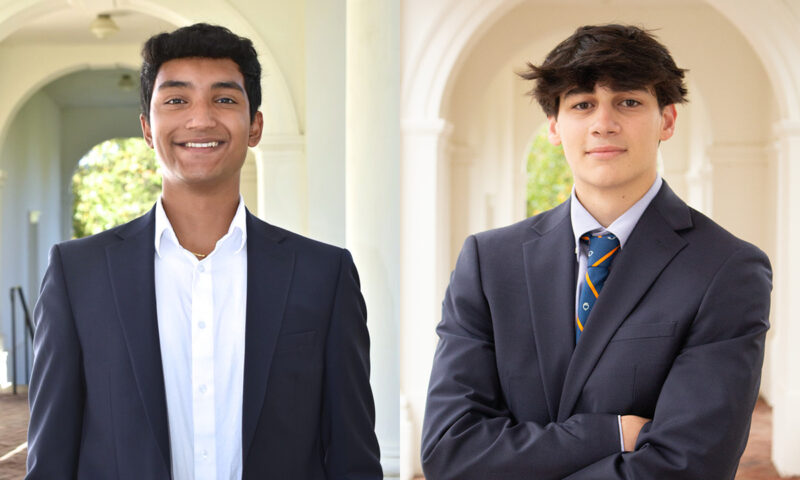
On a recent Saturday at the Northern Virginia campus of UVA’s McIntire School of Commerce, a group of graduate students gathered around a conference table to debate a fundamental problem: whether teams fail because members disagree too much, or because they avoid disagreement altogether. The students, all enrolled in the M.S. in the Management of Information Technology (MSMIT) program, were doing something that might seem unusual for a graduate business course: learning how to disagree better.

Pat Mahoney
“We had a great discussion about our team being prone to arriving at the wrong decisions through avoiding talking about something, or people too quickly agreeing to things,” recalls Pat Mahoney (M.S. in MIT ’26), a Senior Customer Success Account Manager with Microsoft and former U.S. Marine. “We make sure we really have buy-in and remember that it’s okay to speak up and disagree.”
Refining the ability to challenge assumptions, communicate effectively, and work through disagreement may not appear in a program syllabus, yet students across McIntire’s professional master’s programs repeatedly describe those skills as some of the most valuable lessons they take away.
In both the MSMIT and the M.S. in Business Analytics (MSBA), the latter offered in partnership with UVA’s Darden School of Business, working professionals find a daily environment that emphasizes communication, teamwork, and real-world application just as much as subject matter knowledge. Both programs pair live online classes during the week with in-person weekend residencies, a hybrid rhythm that lets students bring what they learn straight back to their jobs, often within days.
Building Community through Collaboration
As these programs are built for people already established in their careers, a large portion of the learning happens among classmates. Teams are intentionally constructed to blend complementary skill sets, allowing students to learn from one another’s professional backgrounds.

Jamal Wade
In the MSMIT program, corporate executives, defense contractors, and tech professionals work in rotating teams where success depends on collaboration. Jamal Wade (M.S. in MIT ’26), a Lead Engineer at Booz Allen Hamilton with over two decades in the defense and intelligence community, emphasizes that though the workload demands total team alignment, the class discussions alone are enlightening and stimulating.
“McIntire leadership did an excellent job of making sure there’s a balance of public and private sector folks who are more business focused in their roles or like myself, on the IT side. They do a great job of differentiating who we’re partnering with, and I love having conversations with my classmates,” Wade says. “The return on my investment in the program is that I’m continuously learning not just from the faculty, but also from classmates. It’s been excellent.”
Connections Beyond the Classroom
Both MSMIT and MSBA students study at the Sands Family Grounds, UVA Darden’s DC Metro campus in Northern Virginia. Crowning the top two floors of a Rosslyn high-rise overlooking the Potomac, the space places McIntire’s professional master’s students alongside Darden MBA students. That proximity opens up additional networking opportunities, as students mix at receptions and topical, business-related events hosted on site.

Sloane Urwin
The weekend residencies are only half of the equation; between those meetings, students speak with professors in live online classes on weeknights. Sloane Urwin (M.S. in Business Analytics ’26) says her cohort works through problems with faculty online in real time, then synthesizes that material during case work at the in-person weekends. “That’s really useful because we’re still able to work with the professors and get assistance where we need it, but we can also work with our peers,” she says.

Devika Jaipuriar
For Devika Jaipuriar (M.S. in Business Analytics ’26), Manager at Forest Trends Association, that in-person/online blend was a deciding factor in choosing the program. “You can feel very siloed in an entirely remote program, so the hybrid format of residencies and Zoom classes really spoke to me,” she says. “I have the flexibility during the week to attend those Zoom classes and do those async classes on my own time, but I also love regrouping every six to eight weeks with my cohort and seeing them in person. We really became a very nice community.”
The career support is just as hands-on, with career counselors available at every residency. They offer all students one-on-one coaching, job-search strategy, and direct connections to UVA’s massive global network of alumni and employers in person, not only online.

Evan Amico
Evan Amico (M.S. in Business Analytics ’23), a Senior Product Manager at Amazon, says the relationships built in the room outlast the degree. “The network is super valuable. But that doesn’t end when the program’s done,” he insists, crediting the School with keeping graduates plugged in through its events and alumni network. “I’ve met a ton of people who didn’t get an MSBA but went to UVA, and we have that connection. There are really not many brands better than UVA, so it’s a great place to me.”
Applying Knowledge in Real Time
For working professionals in both programs, those connections and the collaborative learning move quickly past the theoretical as the transition from classroom to office can happen overnight.
Nicholas Ransing
Nick Ransing (M.S. in Business Analytics ’26), who spent six years at Freddie Mac and is now a Senior Consultant at EY, chose the program because its project-based courses mirror the way work actually gets done. “One of the things that actually really brought me here was a project with Hilton, where we worked with them to do predictive analytics and almost work as consultants,” he says. “I thought that real-life, real-time stuff was a lot more impactful and would actually help me in the workforce.”
“You get to do real market research,” Ransing says. “And then you get to take Python and Tableau data analytics that they’re teaching you, apply that to what you’re researching, and then learn to give executive presentations.”
For Urwin, who landed a new role as a Program Control Analyst with a government contractor just four months into the MSBA, that transfer happens every day. “This program is really helping me understand how to effectively communicate data and make it usable for senior leadership,” she says. “Now I’m able to more effectively present my data and tell a story with my data in a way that will make change within my company.”
In the MSMIT program, the same immediate application of skills applies.

Lindsay Forcade
Lindsay Forcade (M.S. in MIT ’26), Digital Transformation & Communications Lead at Lockheed Martin, found that frameworks covering enterprise architecture, cybersecurity, and technology implementation were readily applicable in her professional life. “These types of frameworks that we’ve been studying have already given me a lens through which to view the world,” she says.
A Worthwhile Challenge
The demands of the graduate programs offer a rigorous amount of traditional coursework, but there’s also the matter of balancing full-time jobs with some intense weekend classes, complex group projects, and regularly assigned presentations.
Yet students consistently describe the challenges as wholly worthwhile.
“There are labs. There are hands-on assignments. There are team projects,” Wade notes. “You are certainly going to need to devote an adequate amount of reading time.”
As someone who worked full time like most of her peers enrolled in the MSMIT program, Forcade feels that the demands have sharpened skills she expects to carry for years. “It really gives you the skills you need to be agile, to be able to adapt, and to be organized,” she says.
Confidence That Carries into Careers
Alongside the technical skills, students in both programs describe another important change: a steadily growing confidence in what they can do, what they are worth, and what they are willing to ask for.
Urwin entered the MSBA with no technical background at all. “I didn’t know how to code. I had never used Python before,” she says. Faculty and course staff supplied material to get her to a baseline so she could keep pace with the rest of the class. Six months later, her assessment of herself had changed completely. “I have gone from zero to being able to do pretty extensive coding,” she says. “I could do just as much as anybody else in the program.”
That assurance carried into her job search, where she credits the program’s career staff with more than job-search tactics. “They’ve been extremely helpful in not only helping me navigate the job process, but also understanding my worth and the value I bring to an organization,” Urwin says. “They’ve really helped me translate all of my past experience and what I’m learning in this program into job functions.”
For Wade, the change shows up in what he now volunteers for. He has typically handed data points to Booz Allen’s business development leads; the program has him ready to make the case himself. “I can say to my leadership that I’d like an opportunity to work a proposal, to be in front of a client, and to pitch how Booz Allen can deliver this,” he says. “I’m grounded, and I’m emboldened, and a lot of that [came] from the MSMIT program.”

John Baldino
John Baldino (M.S. in Business Analytics ’26), Chief Operating Officer of the business controls function at Citadel Securities, describes a more analytical version of the same development, one that has taught him to trust and to test his own instincts. “When you examine something and you think the data may have led you to one conclusion, but something tells you it doesn’t quite seem right, there are ways to challenge my own hypotheses and see where I could be more confident,” he says. Even the pressure of the classroom has a purpose. Being cold called mid-class, Baldino notes, was “the perfect equivalent to being in a meeting where you may not have all of the information in front of you, but you need to know how to react.”
Mahoney, who spent 21 years in the Marine Corps before joining Microsoft, knows how much self-assurance is critical to a successful career change. Translating military experience into private sector terms, he says, required “having the confidence” to recognize what carried over. “I might have never done sales or pre-sales or post-sales; but I’ve sold people on ideas. I’ve led from the middle. I’ve inspired people. I’ve managed budgets,” he says. “It’s not an exact alignment. But it’s translating the skills, mostly through storytelling instead of showing a resume.” He views the degree in similar terms, as evidence of capacity rather than a credential alone. “If I want to get to the next level, this shows that I’ve got something tangible and I’m willing to put in the time,” he says.
For graduates, that confidence tends to show up as movement. Amico stayed at Amazon but shifted from marketing into product management. “A lot of my peers in the program were able to take the education and jump into a brand new role, a brand new job opportunity,” he says. “I went from more of a marketing role into this product management space, and this program absolutely helped me to do that.” Forcade sees the same trajectory ahead of her. “In the long term, I’d love to continue this work in transformation,” she says. “There are lots of different opportunities out there, and I can definitely see in the future that it’s going to continue to equip me with these skills that I need to be successful.”
Whether students are building analytics models for real clients, presenting Monday morning what they learned over the weekend, or learning how to grapple with team communication more effectively, they describe a common experience. By working through those challenges together, online during the week and side by side at residencies, McIntire graduate students find that the most valuable assets they leave with are not just technical expertise, but the confidence and the judgment to navigate the human complexities of modern business and to pursue whatever comes next.