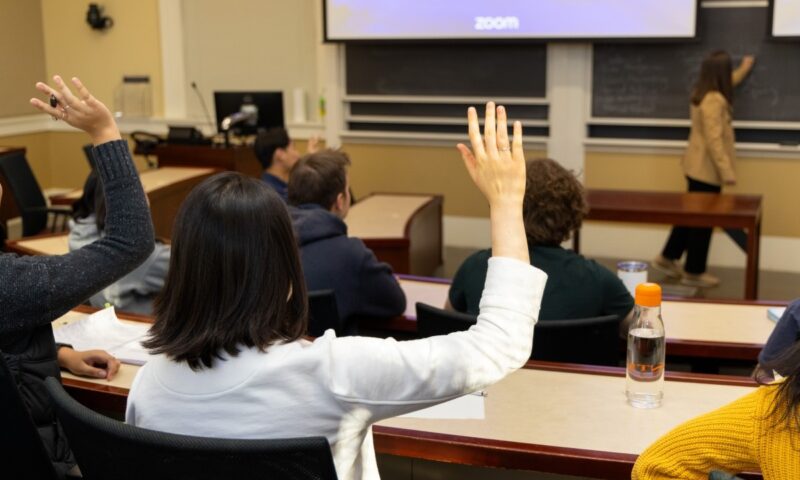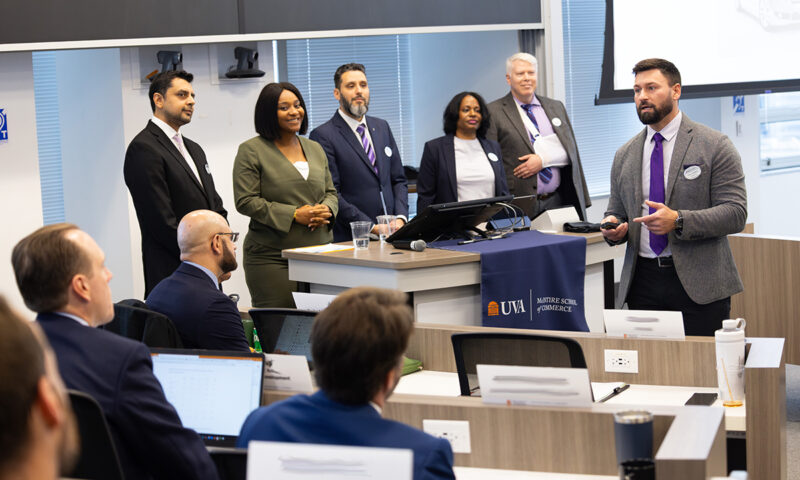

Barr Gill wasn’t sure he would fit in. A 2026 M.S. in Commerce graduate who had done his undergraduate work at Colgate, a small liberal arts college, he arrived at UVA bracing for the experience of disappearing into a crowd. “I was concerned about coming to a university with 20,000 students,” he recalls. What he found instead was a program of roughly 135 people, further divided into two sections, so that he spent most of his time with about 65 classmates he came to know well, building the kind of close relationships with faculty and peers he assumed he had left behind in undergrad.
Gill’s surprise is a common one. Across McIntire’s full-time master’s programs—the M.S. in Accounting (MSA), the M.S. in Commerce, and the M.S. in Global Commerce (MSGC)—students who expect a large, impersonal graduate experience tend to describe the opposite: small cohorts, constant collaboration, and a daily rhythm in which communicating well matters as much as the coursework. The skills they come to value most—learning to challenge assumptions, work through disagreement, and speak up—rarely appear on any syllabus.
A Close-Knit School Inside a Huge University
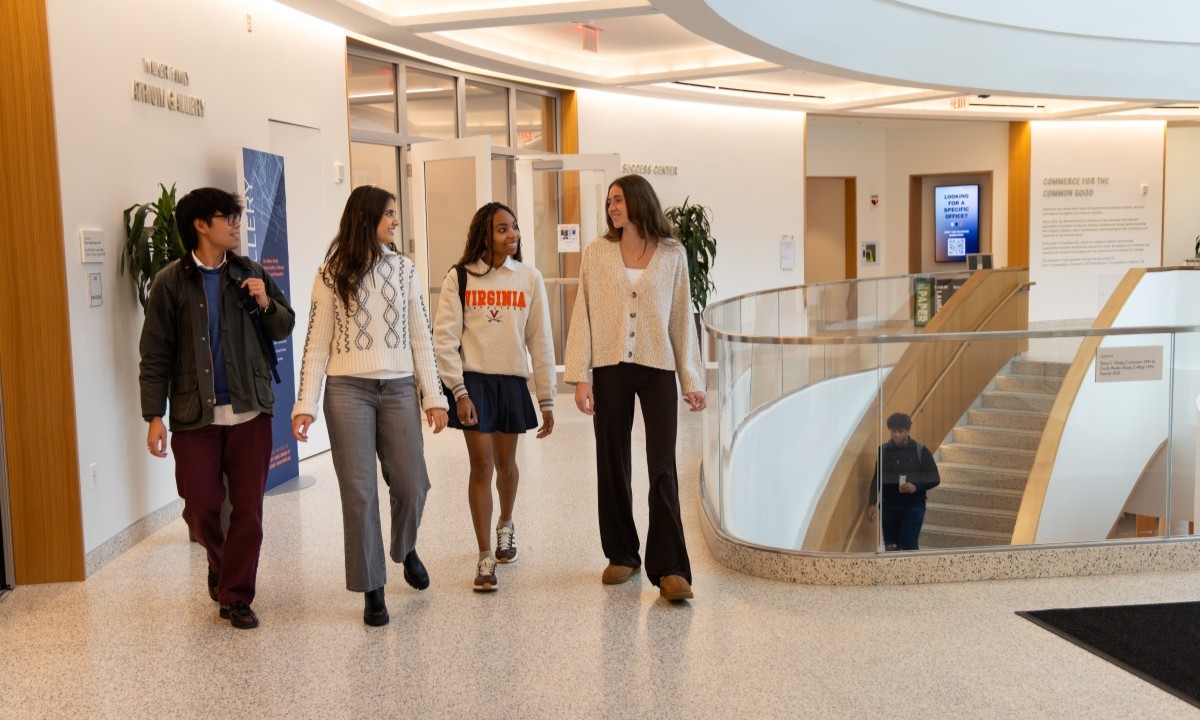
All of this unfolds on the University’s historic Grounds and inside the same Commerce School that Poets&Quants named the nation’s #1 public undergraduate business program for 2026. Even as pre-experience students (those who have yet to begin their careers), the master’s candidates learn from the same faculty and work in the same facilities that earned that distinction, an advantage that becomes obvious from the first week of class.
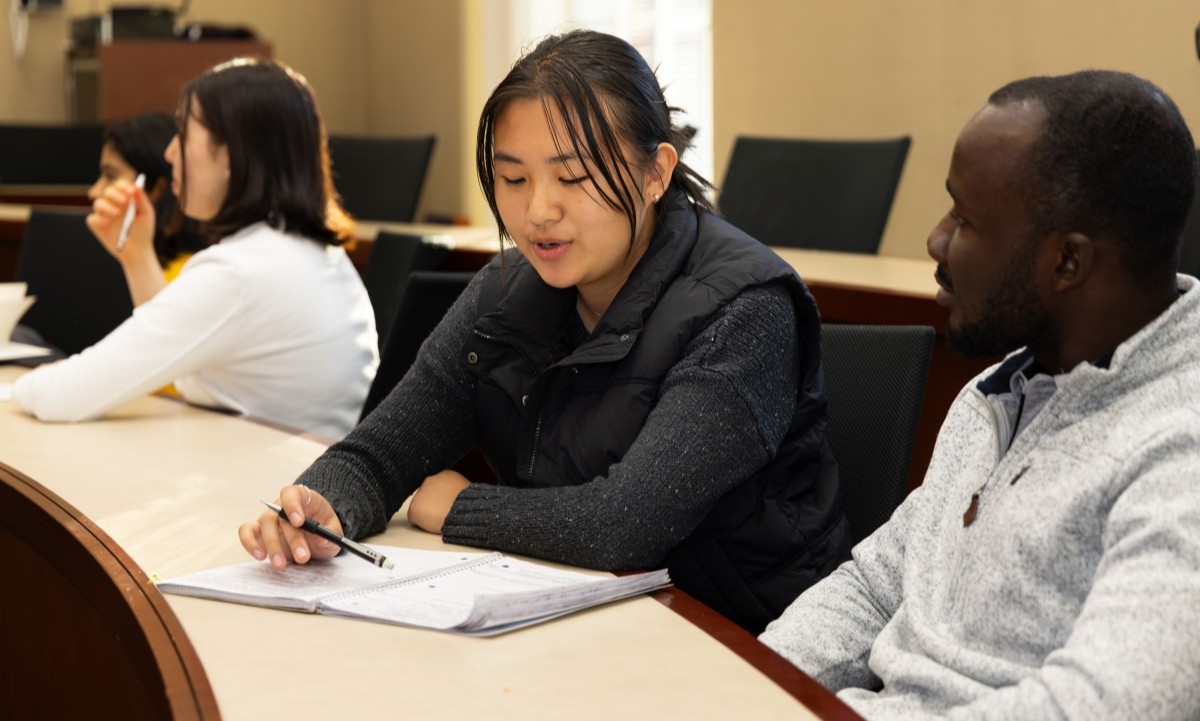
McIntire’s M.S. in Accounting prepares students to combine accounting and analytics to solve complex business challenges, deliver impactful client presentations, and lead with confidence.
For Smriti Katwal, a 2026 MSA graduate who completed her undergraduate degree at Hollins University, the change manifested immediately in how much of the work happened collaboratively. “I never had so much group work in my undergrad,” she says. “Every [MSA] class had some kind of group assignment, which makes people form connections, and it mirrors how you would have to work in the real world.” Professors made time for her during office hours and beyond, and within her cohort of 53 students, the program felt personal from the start.
Jackson Tysinger, another 2026 MSA grad, describes days that are as much about communication as content. “It’s been a lot of hands-on activities,” he says. “Much of what McIntire is comes from communicating between peers, not just giving an answer to the professor.”
Communication and Decision-Making
For many students, the lessons that prove most durable have little to do with the technical side of accounting, analytics, or trade policy. They’re about people.
In the MSA program, leadership courses push students to look past rules and formulas. Katwal recalls presentations, storytelling exercises, and simulations built to sharpen interpersonal skills that may have been considered a problem area. “A major emphasis was given on communication,” she says. “I feel more comfortable now.”
Sealy Smith (M.S. in Accounting ’26) points to workplace simulations that demanded impromptu speaking and real-time decisions. In one exercise, students were handed a stack of competing demands and asked to triage them on the spot, ranking them in order of importance. “There’s a lot more real-world application to situations we would find on a typical workday,” she says.
M.S. in Commerce 2026 graduate Catherine Chénier-Gagnon tells a similar story. She came to McIntire from a neuroscience background and completed the Biotechnology Track. Chénier-Gagnon notes that her Organizational Behavior course stood out for the way it bridged psychology and workplace leadership. “It reminded me a lot of the Psychology courses that I’ve taken before, but then applied them to the workplace,” she says, “and how it can factor into workplace dynamics and different leadership types.”
Class Collaboration Around the World
In the MSGC program, many of those same lessons in collaboration and communication are learned across cultures and continents. Here, daily learning reaches well past the edges of Grounds, supporting students as they live and study in the U.S., in Europe, and around the world.
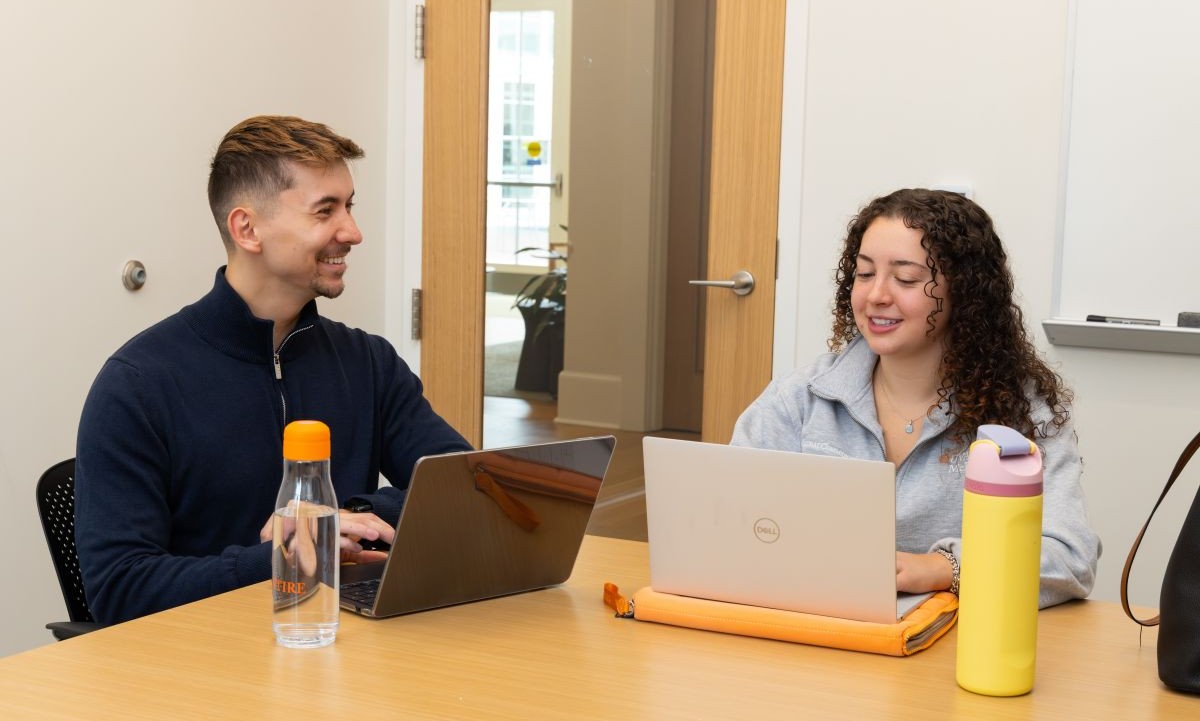
Offered in partnership with ESMT Berlin, McIntire’s M.S. in Global Commerce prepares students with advanced business skills and international experience across two continents.
That sense of community often takes root before classes even begin. During the fall semester in Charlottesville, MSGC students have the option of living together at Global House, sharing the home with classmates from partner school ESMT Berlin over group-project sessions, potluck dinners, and weekend outings. Living and learning under one roof, students say, turns a global cohort of near strangers into a close network well before the program continues overseas.
Jack Witmer (McIntire ’25, M.S. in Global Commerce ’26) entered with a clear personal goal. “I’ve never been outside the U.S. before,” he says. “One of my big goals was to be outside the country and experience other cultures, in less of a tourist way and more like a local.”
The program weaves travel together with coursework in management, marketing, negotiation, and supply chain management, filling gaps that a traditional classroom had left open. For Witmer, the value of that immersion is hard to overstate. “The program is a great step outside of your comfort zone,” he says. “To be able to go see the world, live within the culture, and meet all these different people is incredibly valuable if you have the opportunity to do it.”
Worth the Work
All of the students we spoke with admit that the Commerce School graduate programs require full attention, tenacity, and a healthy dose of time management. Asked for the most honest thing she could say about her year at McIntire, Katwal does not hesitate. “Whenever I told people I’m taking 15 credits, they ask me how I’m surviving,” she says. “Be prepared. It is rigorous. It is a lot.”
The demands run past traditional coursework. Depending on the program, a week might mean juggling overlapping group projects, traveling internationally, and delivering one presentation after another. Even so, students return to the same verdict: The work is worth it, and the collaboration that fills their calendars is also what builds their confidence, their friendships, and their networks.
The payoff for graduates is clear. Even as pre-experience students with little to no full-time work history, McIntire’s master’s candidates have access to the recruiters who come to Grounds each year, representing major global corporations as well as smaller national and local firms. More than 300 companies recruit at the Commerce School annually, and a dedicated career services team readily helps students foster connections that often result in job offers.
Gill, who once worried about getting lost in a crowd of 20,000 UVA students, left with a network of people he now counts among his closest friends and connections. The technical training is real—they acquire deep knowledge about accounting, analytics, and global supply chains—but what most of these students describe carrying out the door is something harder to teach: the ability to work alongside other people, and to be heard.