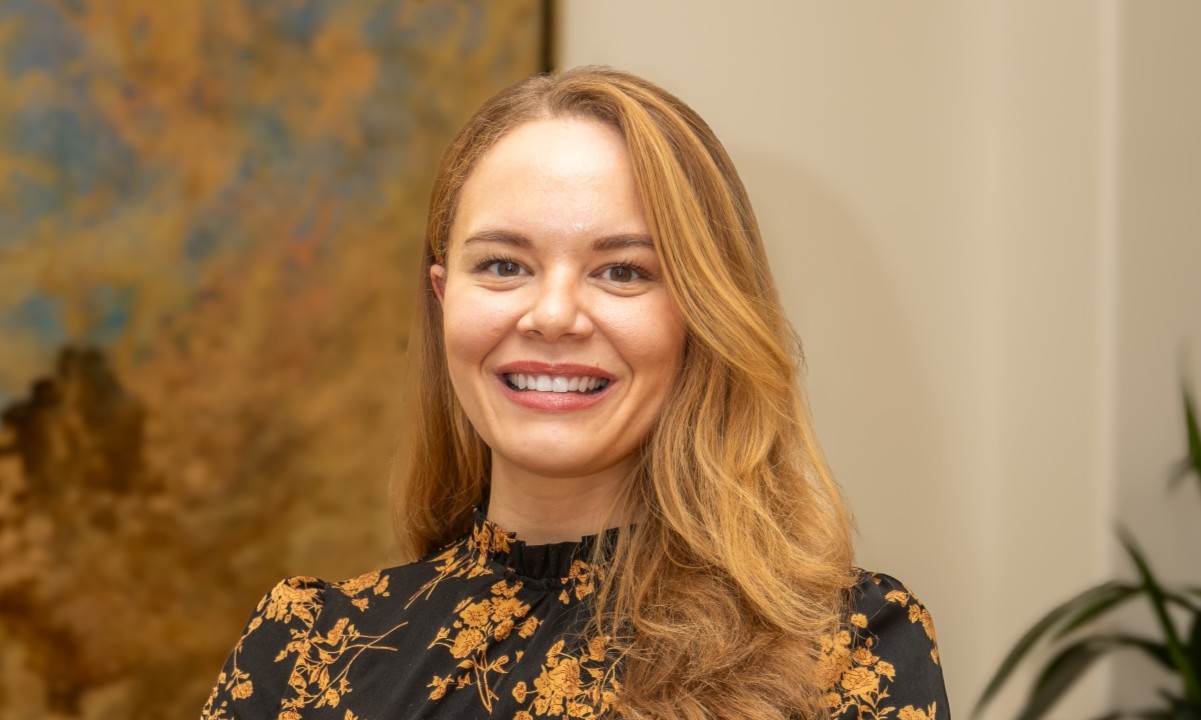

Lindsay Forcade didn’t need another credential to prove she could lead. With more than a decade of experience spanning positions with the Obama administration, the Treasury Department, Deloitte, and now Lockheed Martin, she already had a solid record of navigating complex situations and bringing clarity to moments of transition. What she wanted instead was refinement: a program that would stretch her technical fluency, fortify her strategic decision-making, and strengthen her ability to guide digital transformation inside one of the world’s most sophisticated aerospace and defense companies.
In her role supporting global strategy at Lockheed Martin, the Digital Transformation Lead recognized that McIntire’s M.S. in MIT Program fit seamlessly with her objectives. As she puts it, “I was drawn to the MSMIT program because I felt that it really sits at the intersection between business, strategy, technology, and leadership. And that’s what I was looking for in a graduate school program.”
That concept of connecting interdisciplinary skills emerges as a defining throughline of Forcade’s experience, both in her career and in her graduate studies. It is also the foundation upon which her long-term goal rests: becoming a principal-level leader at Lockheed Martin, guiding major transformation efforts across the enterprise.
The MSMIT Curriculum as a Strategic Accelerator
In her role, Forcade leads what some would call the “people side of technology adoption” by reinforcing communication, readiness, training, and alignment. New systems, tools, and processes often mean steep learning curves for thousands of employees, and she is responsible for ensuring that those transitions feel clear rather than chaotic. To do that well, she must work across technical, operational, and business functions, often acting as both translator and strategist.
The MSMIT curriculum met her where she already excelled while building the technical perspective she sought. “I wanted a program that wasn’t just going to teach me frameworks,” she says. “I wanted one that would challenge me to think critically about how to drive transformation in a complex environment and give me the language that I needed to communicate with lots of different types of stakeholder groups.”
Even in the early stages of the program, she found that courses were strengthening her day-to-day work. The module on digital transformation provided “a baseline about the types of different initiatives that are happening, not just at Lockheed Martin, but elsewhere too.”
But it was the deeper dives in subjects such as enterprise architecture and cybersecurity that expanded her technical competence in ways she could apply immediately. “We’ve already spent a lot of time on enterprise architecture and strategic alignment,” she notes. “Those are things that have helped me understand how our data is managed and how we are working to access controls around data, which was really helpful for me because I don’t come from a technical background.”
This multidimensional academic grounding has sharpened her ability to collaborate with engineers, cybersecurity teams, and executive leaders across the company. The coursework is clearing the fog around complex systems thinking. “These types of frameworks that we’ve been studying have already given me a lens through which to view the world,” she says. “It’s helping to clear the debris from that lens, and these concepts are becoming a lot more tangible.”
A Career Built on Communication and Cyber Awareness
Forcade’s journey into digital transformation started in Washington, DC. Serving as an appointed official in the Obama administration exposed her to leaders who excelled at communicating clearly, navigating ambiguity, and championing innovation. “What I learned from that early period was the value of communicating and being really clear,” she says.

Lindsay Forcade and Deloitte colleagues
Technology was advancing quickly. She recalls participating in the shift toward webinars and virtual communication as early as 2014. At the Treasury, she gained her first hands-on exposure to cybersecurity, collaborating with “the cyber team to bridge that gap” between technical operations and organizational communication. She later deepened her experience at Deloitte, working closely with various security teams and absorbing best practices related to team structure, incident response planning, and workforce training.
Those collaborations have become integral to her perspective as a professional graduate student. “Having that early experience working directly with cyber teams really informed me of best practices within cyber,” Forcade says. “Hopefully, I’m able to bring something to the table in terms of the class discussion.”
Because many students also come from cybersecurity roles across government and industry, she finds the exchange of perspectives energizing. Conversations around implementation challenges, training models, and organizational culture often unfold across sectors; it’s a dynamic that reflects the real-world complexity of digital security today.
A Cohort that Mirrors the Digital Economy
Forcade regularly returns to the strength of the MSMIT cohort as one of the program’s greatest assets. Her classmates represent a broad spectrum of industries and functions, from aerospace and defense to finance, consulting, and federal agencies. She calls that diversity of thought “a powerhouse” that features “many different perspectives that make for very interesting and engaging conversations.”
The faculty contribute to that richness as well, not only by teaching core concepts but also by incorporating active research and real-world case studies. She points to a recent class with Professor Ryan Wright as an example: “He was explaining his research to us in real time about the types of cyber training that have proved to be the most effective.”
Just as valuable is the program’s structure. Forcade balances her demanding full-time role at Lockheed Martin with her studies, yet the MSMIT’s format enables her to push herself without being overwhelmed. “It’s definitely rigorous,” she admits, “but at the same time, I enjoy the challenge of managing everything. It does make me better [because] I really have to be focused with my time.”
For her, making a schedule and sticking to it is part of the point. Working in a fast-paced field requires agility, prioritization, and adaptability, the very skills the program naturally reinforces.
In many ways, the MSMIT program is already shaping both her short- and long-term career ambitions. She sees it giving her the tools to excel today while positioning her to lead transformation efforts long into the future. And its benefits, she believes, extend to students from any background, whether they’re particularly technically advanced or not.
Asked to consider what type of person would thrive in the program, she offers an answer that doubles as a reflection of why she herself enrolled. “For either of those groups of people, this is a really great program for them, because it’s going to give them that IT really technical background that they may need to be successful,” Forcade says.


