When John Kyburz was 12 years old, he was at a festival in Maryland when he encountered a food truck for the first time. He had fried Oreos and was so taken by the dessert, he kept going back for more until he made himself sick. Somewhere in between those trips back to the truck’s window, he decided he wanted a food truck of his own.
“I came up with the name Waffle Wheels, with the tagline, ‘We Bring Breakfast to You,’” he recalls. He told his teachers about his idea, wrote business plans, and even did a high school project on the concept. People around him saw it as a funny childhood dream. But he didn’t let it go.
Roughly 13 years later, he acted on it. Kyburz launched Waffle Wheels as a food truck in Nashville, and growth came quickly. “Now we are making plans for our third location this year,” he says. “It’s crazy.”
The business now operates out of a food truck park in Lebanon, TN, an event truck for corporate catering and private bookings, and new venue partnerships across Nashville. Kyburz describes the approach behind that expansion simply: “Creating win-win solutions has been a huge part of our growth.”
Behind all of it is a guiding philosophy. “Entrepreneurs are here to solve problems,” he says. “You have to find the problem and work backwards from there.”
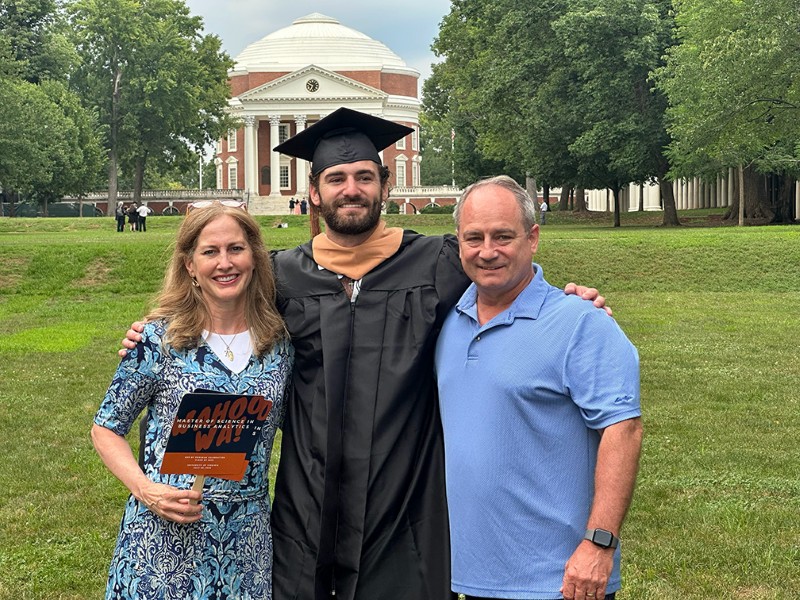
That mindset was sharpened during his time in UVA’s M.S. in Business Analytics (MSBA) program, which he completed while building the business.
Balancing graduate school with a growing operation wasn’t easy, he admits, but the one-year program offered jointly by the McIntire School of Commerce and Darden School of Business gave him tools he could put to work immediately. A project management course introduced him to critical path analysis, which he now applies directly to kitchen sequencing, resulting in faster ticket times and clearer systems. A prototyping course reinforced a philosophy he has carried into every part of the business. “The goal you’re trying to reach isn’t on the other side of time,” he says. “It’s on the other side of iterations and insights.”

That same experimental approach shows up in day-to-day decisions. A customer analytics course taught him about A/B testing, a method he is now applying in practice. “Right now, we’re going through the same process for seeing which type of fries our customers prefer,” he says.
A custom knowledge base lets operators and future franchisees find answers independently, freeing Kyburz to focus on growth. But he is clear that technology follows systems, not the other way around. “You can’t try to do the tech first and then build the systems around it,” he says. “It’s going to be like the cart driving a horse.”
Kyburz says the most rewarding part is still the simplest one: “I like seeing things come to life.”