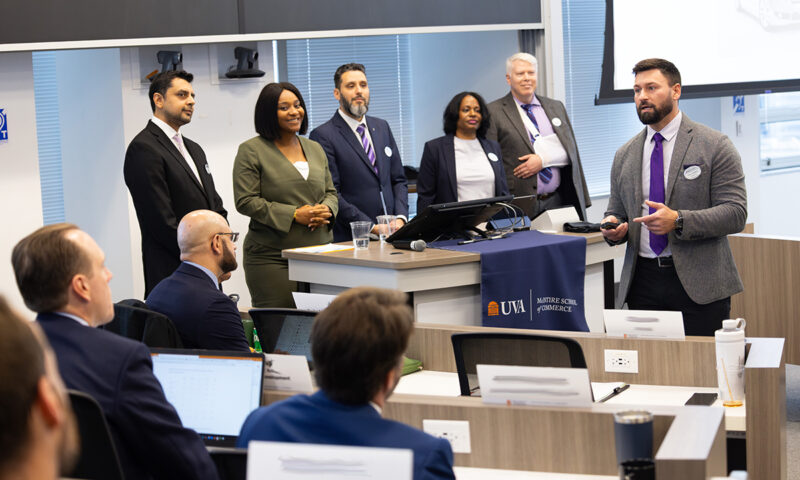

A working professional sits across from a senior technology executive, defending a proposal that could change how their organization operates. They have about 20 minutes to make the case. This is EOG Day, the culminating experience of Module 3 in McIntire’s M.S. in the Management of Information Technology (MSMIT) program, and for many, it is the first time they have presented and defended a real idea in front of a leader with the authority to build one.
The MSMIT at UVA’s McIntire School of Commerce is built for those who want to lead at the intersection of business and technology. Each person in the program writes a digital innovation memo, a concise recommendation proposing a new technology initiative for a real organization, usually their own employer. On EOG Day, they brief an Executive-on-Grounds (EOG), a senior leader who evaluates both the substance of the idea and how well it is communicated to an executive audience.
What makes the experience unusual comes from the exchange. EOG Day gives participants the rare chance to take a problem specific to their own organization, refine the thinking around it in real time, and explain it to an accomplished outsider.
The EOG, often an MSMIT graduate, brings hard-won experience to pressure-test a real initiative and offer genuine expertise. The professional, in turn, sharpens the skill that matters most in a career: making a complex idea land with a busy decision-maker. Few graduate programs hand anyone an interaction like that.
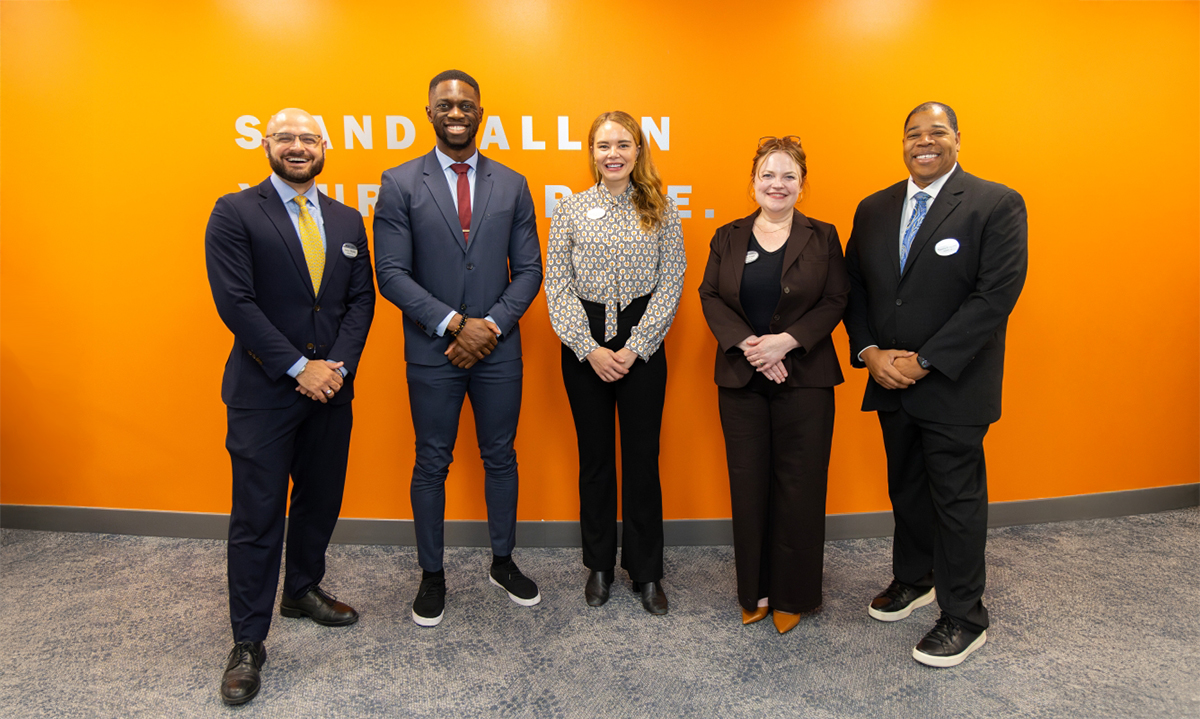
That value becomes clearer through the people who have experienced EOG Day from both sides of the table. Three MSMIT alumni who have returned as EOGs describe what that time can do for those enrolled in the program and aiming to advance their careers.
A Change of Seat
Michelle Farr (M.S. in MIT ’20), now a Chief Information Security Officer and Vice President at NXP Semiconductors, says that being in the executive’s chair reframed the entire exercise. “When I sat in the student seat, defending my digital innovation memo, I believed the executive across the table was there to judge me,” she recalls. Taking the other seat changed that. “The executive was not there to judge. The executive was there to invest. The hard questions were the investment.” She is candid that the learning still flows in both directions. Reading five memos side by side this past May, she says, “showed me patterns I carried straight back into my own work as a CISO.” Her takeaway: “I came to give feedback and left with notes.”
 For Katy Robb (M.S. in MIT ’11), who rose to become a Chief Information Officer with Milliman IntelliScript and now coaches senior technology leaders, the conversations reach a familiar place. After talking through a proposal, she notes, “Underneath many of them is a very human question: ‘Can I really do this?’” Her answer comes from experience: “Uncertainty doesn’t disappear as your title gets bigger.” She traces her own ambition to a brief exchange with her EOG, Lyn McDermid, then the CIO of Dominion Energy. “She challenged me, not directly, but simply through her example to think bigger about what might be possible for my career.” Robb hopes to pass that forward, so that students leave with more expansive ideas “about what they can achieve than they did when they sat down.”
 Harpreet Peleg (M.S. in MIT ’20), a seasoned finance and investment executive who entered the program to deepen her technology fluency, believes the value of EOG Day starts with honesty. The Chief Financial Officer of the AFL-CIO Housing Investment Trust opens each session by admitting that she struggled with the very same digital innovation memo. “I also share that I did not do particularly well on that assignment,” she says. “It usually helps put students at ease.” Once the students’ nerves fade, their strengths become clear. “I am consistently impressed by their creativity, resourcefulness, and willingness to work through ambiguity when information is limited.” For Peleg, the connection does not end when the session does. “The MSMIT experience did not end at graduation,” she says, describing a program that “is more than a degree; it is a community.”
A Conversation That Gives Back
That sense of community runs through all three accounts. The executives return not only to evaluate but to invest, and they leave having gained something themselves. “I’ve left EOG Day with the feeling that I received much more than I gave,” says Robb.
For prospective applicants, the appeal is concrete. EOG Day offers a rare opportunity for candid, high-stakes feedback before the stakes are real, focused on a problem they actually own at work. As Farr describes it, “Candid feedback, delivered with respect, is the scarcest resource a rising leader has.” Participants leave with more than a grade: a sharper idea, a wider network, and the experience of defending their thinking to a seasoned executive who genuinely wants them to win.
For alumni, the program is an open invitation to return and invest in the next group of leaders. Peleg hopes everyone walks away “knowing that they have people in their corner, both inside and outside the program, who are rooting for their success.” And for the executives who come back, the experience leaves them optimistic about who is coming next. “The profession is in good hands,” Farr says. “I have seen them.”