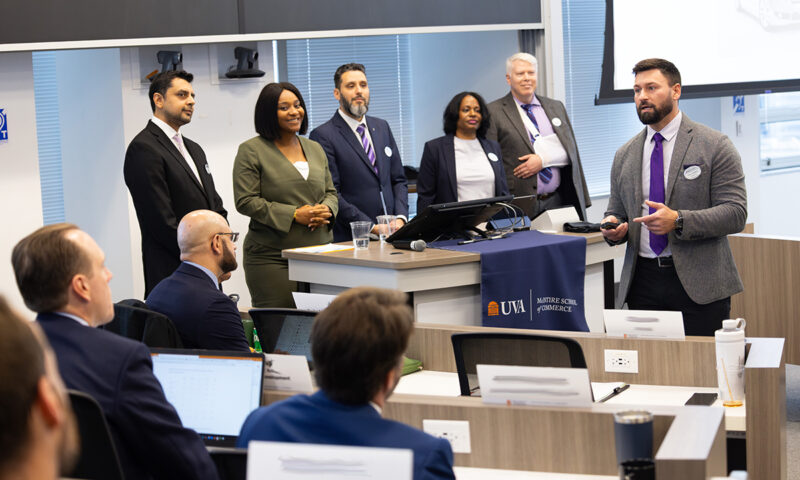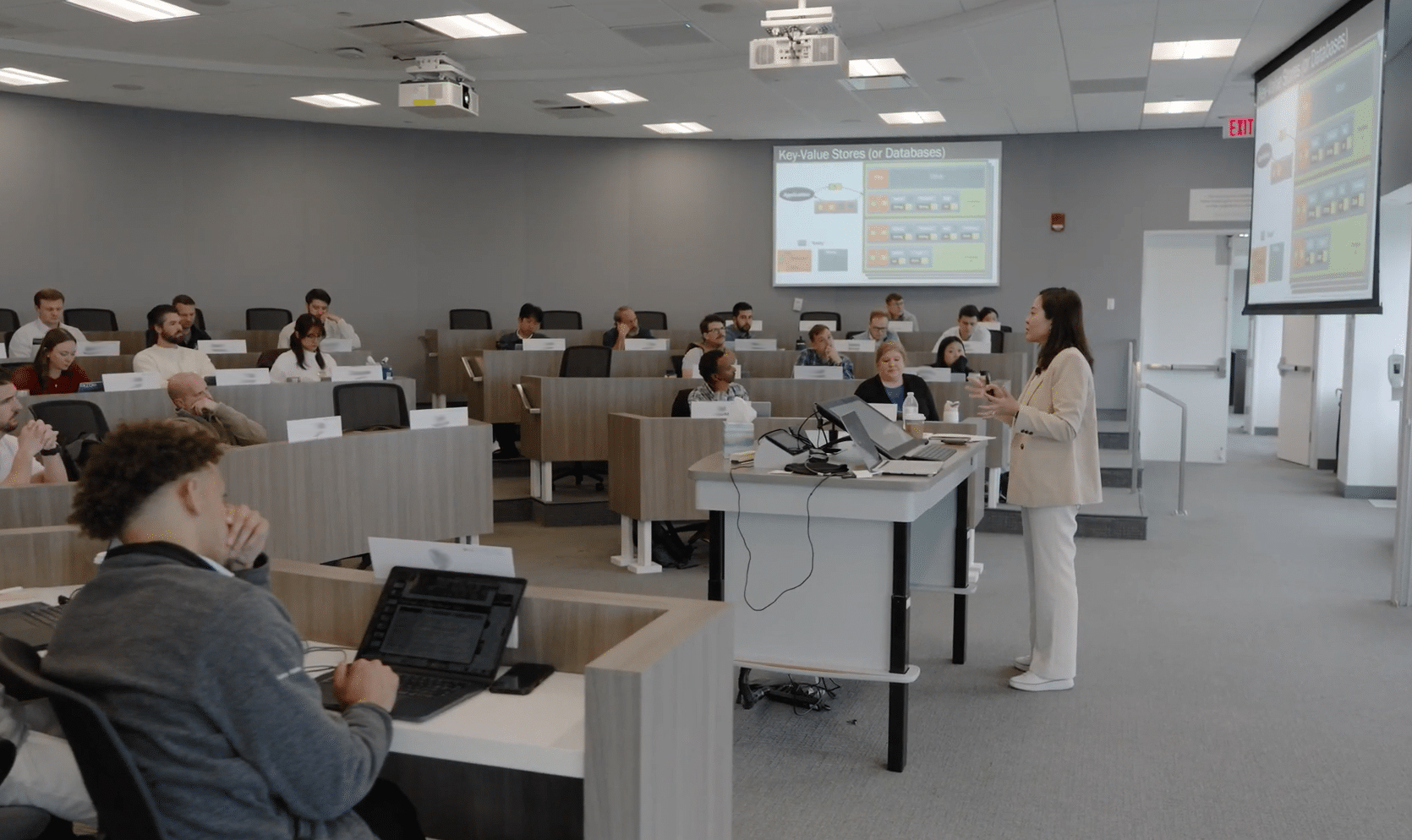

One team is trying to predict which Hilton employees will quit before they hand in their notice. Another is building AI agents that pass work back and forth like colleagues. A third is designing a system to help the FDA catch dangerous drug reactions before they spread.
At first glance, the assignments look unrelated. Together they trace a single arc. As AI makes technical execution faster and cheaper, the scarce skill is no longer building a model. It is connecting models, systems, people, and strategy into decisions an organization can act on. Models become tools. Tools become systems. Systems become strategy.
That progression drives the curriculum of the M.S. in Business Analytics (MSBA), offered jointly by UVA’s McIntire School of Commerce and the Darden School of Business. Rather than teaching analytics as a set of technical tools, the program is built around a sequence of integrated projects in which students ship real products for real users: modeling and prediction, then agentic systems, then organizational transformation, and finally a capstone where all of it converges. The goal is not to produce better analysts. It is to develop analytics leaders.
Learning to Build Models
In Professor Reza Mousavi’s Data Analytics II course, students tackle the Hilton Project, a module-long engagement built on real Hilton employee data. Mousavi, an Associate Professor of Commerce and former Lead Data Scientist at State Farm, structures the work around a reality of modern analytics: The best model is not always the most valuable one.

Reza Mousavi
Teams compete in a private Kaggle competition, building AI models used in HR analytics. The models can help Hilton understand what they do best (and what they could do more of) in order to keep their employees happy. Students make at least three submissions a week. But while the students chase a better score on a leaderboard that rewards raw predictive performance, accuracy alone is not the assignment.
Alongside their high-performing models, teams build simpler, interpretable ones and use explainable AI techniques such as SHAP (SHapley Additive exPlanations) and then package the analysis into a working web app they present directly to Hilton representatives.
As model-building becomes more accessible, the advantage for MSBA students lies less in generating predictions and more in helping an organization act on them.
Learning to Build Systems
If the Hilton Project teaches students to create and explain insight, the next step is learning how insight becomes part of daily operations. In Professor Ryan Wright’s Digital Transformation with AI course, students stop analyzing systems and start building them. Wright, the Rolls-Royce Commonwealth Eminent Professor of Commerce and Co-Director of AI Research at UVA, built the course around a capability employers are scrambling to develop as agentic systems move from experiment to production.
“Students finish the course able to do work that employers are actively trying to hire for right now,” Wright says, “which makes it well suited to career-switchers and anyone building out a portfolio.”
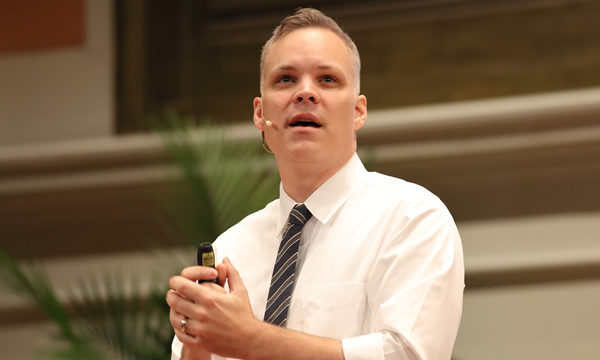
Ryan Wright
Students ship working agents on two deliberately different stacks: a low-code enterprise platform, Microsoft Copilot Studio, and a code-native environment, Replit. They ground agents in organizational knowledge, give them decision logic, and orchestrate several at once, with a coordinator agent handing tasks to specialists beneath it. The applied data is the same Hilton employee dataset from the modeling course, closing a neat loop: A model that once predicted attrition becomes a tool an agent can call on demand.
Just as important, students learn that AI initiatives are rarely technology problems. Organizations have to define objectives, prepare employees, redesign workflows, and manage adoption, and students work through change frameworks such as ADKAR and the Prosci Change Triangle Model to do it. As one report the class studies describes it, the main barrier to AI adoption is rarely the technology; it is people and culture.
Learning to Build Organizations
That perspective anchors Professor Jingjing Li’s Managing Big Data course. Li, Co-Academic Director of the MSBA and a former Microsoft Scientist, pushes students past algorithms to the architecture and strategy that let analytics products function.
“It is not enough to teach them how to build models,” Li says. “Organizations need business leaders who understand how AI reshapes culture, operations, customer experience, and strategy.”
Li extends that lesson through the program’s industry treks, where students evaluate real companies using the Gartner AI Maturity Model.
On a recent visit to Washington, DC, they spent two days inside organizations at very different points on that curve, and the contrast was the lesson. At the most advanced, Microsoft, AI agents are written directly into the org chart, including an onboarding companion that answers new hires’ questions around the clock, the very job Li recalls struggling with during her own first week with the organization.
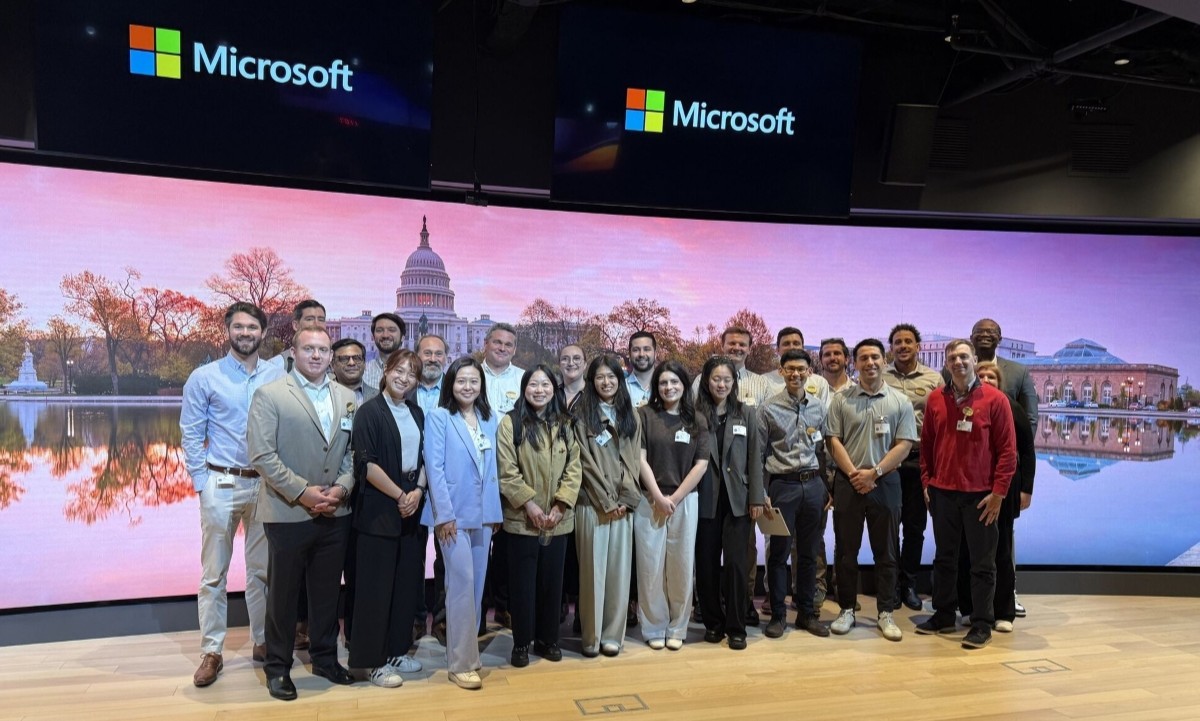
MSBA students visit Microsoft in Washington, DC.
At Guidehouse, a $2 billion bet on AI and a new division had teams moving fast enough that one recent hire reportedly finished a pilot in two days. At the other end of the curve, heavily regulated organizations can take years just to approve a model for internal use, so employees treat AI as little more than copy-and-paste. Reading where a company sits, and why, helps students understand the organizational conditions that let AI initiatives succeed—or stall.
Putting It All Together
The progression culminates in Module 4, where modeling, systems design, organizational strategy, and AI deployment converge on a single product: an end-to-end system to help the FDA catch adverse drug reactions earlier. Such reactions account for as much as 12% of hospital admissions and more than 100,000 deaths a year; the blood thinner Pradaxa alone was tied to thousands of hospitalizations and $650 million in settlements. The FDA receives roughly 80,000 adverse event reports a year, hundreds every workday, and confirming a signal can take weeks or months.
Students attack the full lifecycle. They interview a real user (a nurse, physician, or safety official), map the internal and external data the system would draw on, from the FDA databases to social media and online forums. Then they fine-tune natural-language models that rate the severity of an adverse-event narrative and return a score and explanation in real time. Beyond the model, teams define transformation objectives and key results; assess where adoption would stall inside a regulated agency; and propose a future-state workflow in which AI agents monitor incoming reports and triage safety signals, escalating the urgent ones to human reviewers.
According to Li, the pieces snap together: The models become tools the agent uses, the data architecture becomes its knowledge base, and the organizational design decides how people work alongside the system and how decisions get made.
The Common Denominator
Hilton predicts who will leave. The agentic systems coordinate work. The FDA system catches harm before it spreads.
The projects differ in purpose, industry, and technology. The skill they demand is the same: the ability to connect data, systems, people, and strategy into decisions an organization can act on. By the time MSBA students finish the program, they have practiced doing exactly that. The tech will undoubtedly change, but the underlying progression of models to tools to systems, and finally, to strategy, will stay with graduates as they advance throughout their careers.