

 When Dutch Senft (McIntire ’25) was 12 years old, his older brother Archer dove into the ocean at the Jersey Shore and hit a sandbar. In an instant, Archer became a quadriplegic, losing the physical ability to make things by hand. Interested in fine art, he shifted his focus to creating digital work and studying art history. Dutch responded by picking up a paintbrush.
That moment sparked a deal Senft would honor: Pursue what you love, and find a way to make it work.
“Having that experience with him and him losing his ability, it just taught me to seize what I want to do,” says Senft. “I’m prioritizing happiness, and so far it’s worked out.”
He arrived at UVA already holding two things at once: a family legacy at McIntire (his father, Bill Senft, graduated from the School in 1983) and a commitment to art. When he fell unexpectedly in love with his Accounting classes, applied to McIntire, and got in, the deal became official. He would do both fully: a double major in Commerce (Marketing) and Studio Art (Painting), plus a minor in Art History.
The first semester was understandably difficult. Balancing McIntire’s Integrated Core alongside advanced painting classes left little room for him to breathe. But after that initial challenge, the two disciplines stopped feeling like competing obligations and started feeling like complements. Because they required different ways of thinking, being in one felt like a break from the other.
Yet something unexpected happened: That tension between the two areas became the foundation for Senft’s work.
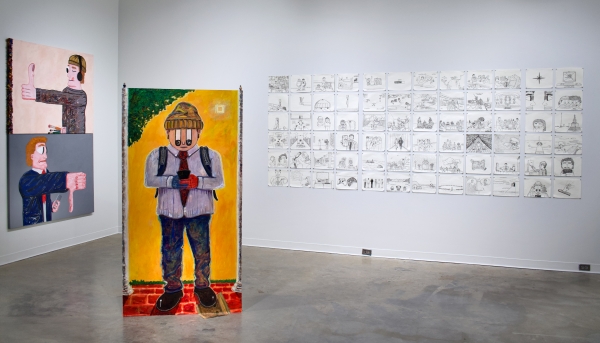
Senft’s April 2026 two-person exhibition at UVA’s Ruffin Gallery, titled THE DEAL, pairs his paintings, drawings, and sculptural casts with film work by fourth-year UVA student Reese Robers. Together, the artists examine recurring archetypes and the interconnected relationship between The Artist and The Businessman. These characters clash, compromise, and move through a world shaped by screens, ambition, and individuality. Is their connection symbiotic or parasitic? The exhibition asks how identity is formed, not outside the systems around us, but from within them.
 And while for most visitors, that might read as an abstract artistic premise, it is lived experience for Senft.
“You think that they’re two completely different things,” he says, “but then you realize that they can coexist, and they’re kind of chasing the same things.” He’s explicit in pointing out that The Artist and The Businessman personas in his work are not mere stand-ins for a devil and an angel. They are two sides of himself, the balanced parts representing a deal Senft has spent years learning to keep.
The visual language of the show draws on Philip Guston, the American painter known for cartoonish late works examining complicity and identity. Senft filters that playful, unsettling aesthetic through his own lens, creating satirical scenes of college life and absurd takes on ambition.
In one of the show’s more striking pieces, Senft made molds from a 3D-printed phone model and cast them in concrete. The work references his McIntire Digital Strategy course with Professor Nicole Montgomery and the question every young artist faces: Do you build a social media presence, or do you resist it? “Unlike in the past, you have to have this digital presence to reach audiences,” he says. The concrete casts manifest that constant yet invisible pressure into physical form.
That intersection of commerce and creativity points toward Senft’s future pursuits. After graduating in 2025, he was awarded one of five annual UVA studio art fellowships, giving him a studio, a stipend, and a year to focus entirely on his practice, culminating in THE DEAL, his final exhibition on Grounds. His next step is an M.F.A. at the Leroy E. Hoffberger School of Painting within the Maryland Institute College of Art (MICA), where he expects to be among the youngest in his cohort. He and Archer are also opening Archer Hawkins Gallery in his hometown, Baltimore, together.
Senft is candid about how his McIntire education in brand development, client relationships, and marketing strategy applies directly to that collaboration.


“My McIntire training has really come into play with developing brand guides, constructing our business identity, and how we develop clients,” he says. “Having an education in commerce and art has put me in a good place for what I want to be. I don’t see myself as just an artist—I also see myself as an arts administrator—so those learnings from McIntire play into that. It’s fun being in that unique place as a part of both worlds, especially since I haven’t met many people who have those two roles.”
For an alumni base that knows McIntire as a launchpad into finance and consulting, Senft is a different kind of success story. Since he didn’t choose one side of the deal, but honored both, the Commerce School didn’t redirect the artist. Instead, it made him a better one.
Catch Up With Commerce
Find out about all the exciting things happening in the McIntire community. Visit our news page for the latest updates.
More NewsRelated Content


A video is being shown