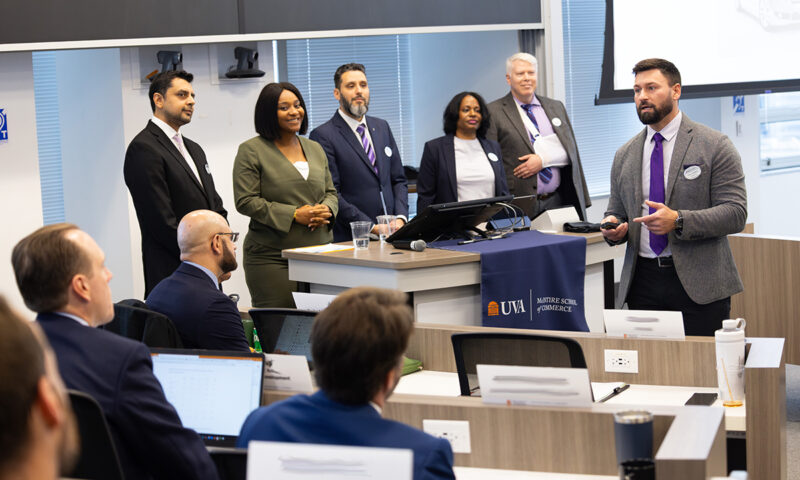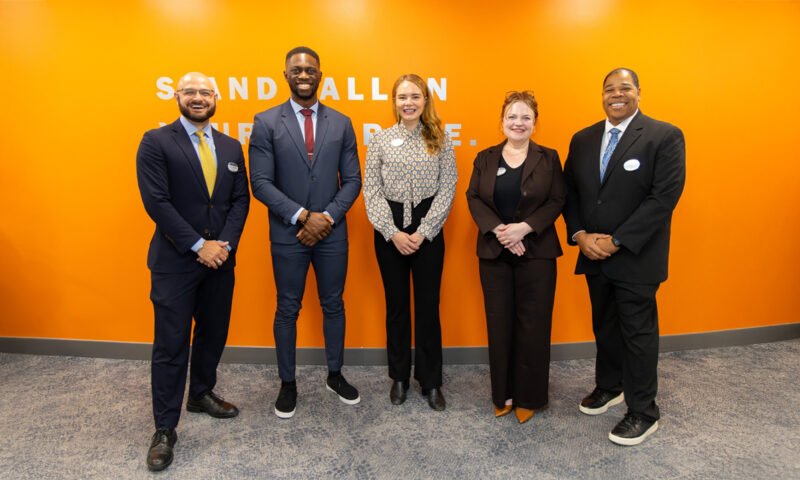
Managing great wealth, it turns out, is a discipline unto itself. A recent Center for Investors and Financial Markets (CIFM) Professional Speaker Series panel brought that reality into focus. The event connected students with three practitioners from a corner of finance rarely covered in a typical syllabus: Janet Arzt (McIntire ’07) of Parere Advisory, Brendan Gallo of Mount Adams Capital, and Brett Snidtker of Prairie Management Group.
Arzt, Gallo, and Snidtker explained that family offices typically emerge when a fortune spans businesses, real estate, and public markets to the point where informal management breaks down. As fourth-year McIntire student Nellie Liu reflected, family offices aren’t just about returns, but about helping families “organize and pass wealth to the next generation,” especially when multiple entities and obligations are involved.
That need has only grown. The panelists noted that family offices have become widespread in the U.S. over the past 15 years, driven by a wave of liquidity events including IPOs, buyouts, and M&A deals that created a new class of families in need of dedicated investment infrastructure.
The real-world examples they brought made that complexity tangible. For example, Gallo’s office inherited a portfolio in which over 90% of the family’s net worth sat in a single stock. Snidtker walked into the opposite problem: a family with more than 500 investments spread across funds and vehicles so sprawling that meaningful oversight was nearly impossible.

Janet Arzt (McIntire ’07) of Parere Advisory, Brendan Gallo of Mount Adams Capital, and Brett Snidtker of Prairie Management Group
As students have spent time in class weighing the merits of diversification, the examples reframed the conversation. Fourth-year Commerce student Mia Luu noted that, while diversification is often emphasized in coursework, in practice it can go too far, producing “a messy, underperforming portfolio that is hard to manage.” Concentrated positions, meanwhile, carry their own complications, particularly when tied to a founder’s legacy and bound up with personal history.
But even well-constructed portfolios don’t exist in a vacuum. Taxes shape nearly every investment decision for wealthy families, yet the panelists cautioned that minimizing taxes should never come at the cost of long-term returns. Holding onto a poor investment to avoid a tax bill, they noted, is a trap that quietly erodes wealth over time. Fourth-year McIntire student Quinn Green captured the underlying principle well: “Even if an investment is not the most tax-efficient vehicle, if the excess return is large enough compared to the alternative, it logically is the superior investment.”
What unifies all of those decisions, though, is something less quantifiable. Unlike traditional asset management, family office work means managing relationships as much as portfolios. Fourth-year Commerce student Maya Kanaan put it plainly: “You’re not only building portfolios; you’re also helping families set up their generational wealth.”
CIFM Director and Professor Mike Gallmeyer reinforced the point, noting that success depends on aligning financial strategy with a family’s values and long-term goals. That mandate often extends into governance, education, and deeply personal decisions that have nothing to do with a spreadsheet.
The panelists also made clear that the field rewards unconventional paths. Each of their routes into family office careers looked different, and they suggested that varied experience is actually an asset in work that demands both technical depth and interpersonal range.
A networking session after the panel gave students the chance to explore those professional avenues, continuing conversations one-on-one with practitioners who have built careers in ways most finance curricula do not explicitly map out. For many student attendees, it was a reminder that connecting with the right people can matter as much as knowing the material.
And with family office investing becoming an increasingly popular destination for McIntire graduates, having those relationships in place matters. “Given their growth, more of our students have been forging careers in this space over the past few years,” Gallmeyer says.
McIntire students are used to dealing with ambiguity, but the panel reinforced the idea that in family office investing, complexity isn’t something to try to eliminate. It’s the job.