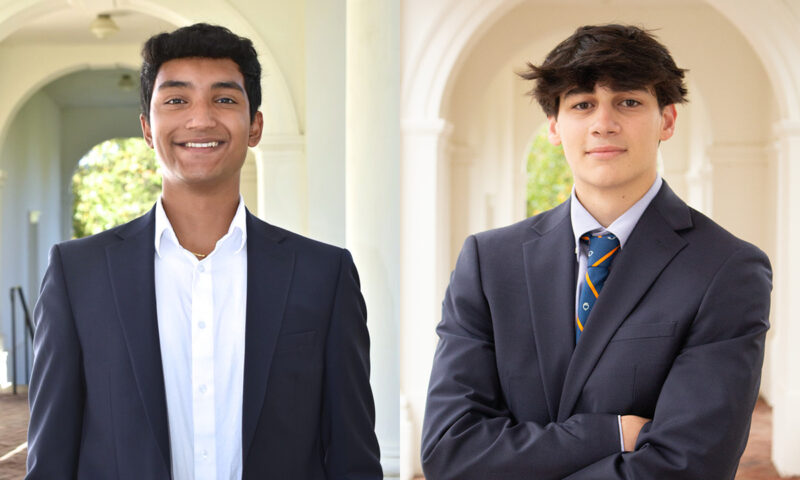
For students coming from rigorous liberal arts schools—like Colgate University, the Hamilton, NY–based institution known for its close faculty relationships and interdisciplinary approach—UVA McIntire’s M.S. in Commerce Program can feel like a natural extension of their undergraduate experience rather than a departure from it. That sense of continuity drew Colgate graduates Barr Gill (M.S. in Commerce ’26) and Aidan Murnane (M.S. in Commerce ’26) to McIntire, where they are now translating what they learned in undergrad into what they can do professionally.
The transition to the Comm School that Gill and Murnane have taken has felt less like a leap into the unknown and more like a logical and surprisingly seamless next step. Designed for high-achieving recent graduates, the M.S. in Commerce Program is offering them an immersive, applied business education that builds fluency in strategy, analytics, finance, and leadership while helping them to prepare for entry into meaningful careers.
How the M.S. in Commerce Builds on Liberal Arts Learning
Gill came to Colgate from Virginia Beach, VA, graduating in 2025 with a major in Environmental Geography and a minor in Writing and Rhetoric. “Environmental Geography is kind of a niche major,” he admits, pointing out that only about 50 universities in the nation still have a Geography discipline. Gill was drawn to the environmental focus early on, calling it “a hybrid between geography and environmental studies, which I have been interested in since middle school.”
But as graduation approached, Gill began thinking about how that passion might translate into a career. “There weren’t a ton of professional opportunities that were dynamic in the way I was looking for that my geography education really would have prepared me for,” he says.
The M.S. in Commerce stood out as a way forward.
“I felt like the program would be a good way to marry that environmental education with a business education and then leverage those to bring into the professional world,” he says.
Murnane arrived at a similar conclusion but came to it from a different academic starting point. A native of Briarcliff Manor, NY, he earned his Colgate degree in Computer Science with a minor in Economics. He most appreciated the breadth of perspectives he explored and subjects he studied in his undergrad program, noting that the liberal arts focus helped him to develop “both as a critical thinker and a problem-solver.”
That foundation made him eager to elevate his knowledge on more targeted business skills at McIntire. “I had always had an interest in business, specifically finance,” Murnane says. “I felt pairing the skills I developed at Colgate with a more technical-focused program, like the Master’s in Commerce, would help prepare me for a career in finance.”
Both students point to Colgate’s emphasis on thinking across disciplines as important preparation for McIntire’s Integrated Core curriculum. “The ability to think critically is certainly helpful in life,” Gill says, “but it’s especially helpful in this education, such as the Strategy and Systems material and being able to make connections with different courses.”
Murnane echoes that sentiment through the lens of applied learning. “The classes I enrolled in for the Computer Science major prepared me well for the M.S. in Commerce Program,” he says, pointing out that while those courses emphasized lectures supplemented by hands-on lab exercises it was a pattern—learning then applying—that has carried over directly. “That same transition from understanding to practice is essential to the M.S. in Commerce coursework.”
Continuity Continues from Colgate to the Commerce School
Despite moving from a small liberal arts college to a large public university, both Gill and Murnane describe McIntire’s academic culture as familiar. Gill says he was a little apprehensive. “Colgate is 3,500 students,” he says, noting how accustomed he was to seeing the same people every day. “I was concerned about coming to a university with 20,000 students.” Those worries eased quickly. “There are about 135 students in the program,” he says, “which was further segmented into the two sections. So really, I’ve spent a majority of my time with 65 students whom I’ve been able to become pretty close with.”
Faculty accessibility also felt like a continuation rather than a change. “I’ve gone and met with many of my professors to talk about class content, what courses I should take next semester, career aspirations, and everything in between,” Gill says. “That’s definitely been similar, and I was pleasantly surprised about it.”
For Murnane, classroom engagement stood out most. “The biggest parallel in terms of the academic cultures is the emphasis on participation,” he says. Even with occasionally larger class sizes, “the professors make an intentional effort to bring the small-class feel to a larger environment. That aspect has made the transition much more seamless.”
Non-Business Majors Find Career-Focused Confidence and Alumni Support at UVA McIntire
Academically, the program has pushed both students in new ways—especially given their non-business backgrounds. Gill describes the analytics transition as manageable. “In terms of data and analytics, the transition wasn’t too difficult,” he says. “We’d have labs every week, and Professor [Roman] Lukyanenko would teach us the basics on whatever technical skill we are learning, whether it’s SPSS or Tableau.”
Murnane found the program reinforced his confidence. “Coming from Colgate, I felt prepared with respect to my ability to learn and then apply new material,” he says. “This has helped tremendously with the combination of both the business and technology aspects introduced in the M.S. in Commerce Program.” He also credits faculty support, saying professors are “abundantly clear with their instructions as well as welcoming to those who are seeking additional help.”
Career preparation is another area where McIntire has expanded what both students brought from Colgate. Gill notes the scale of opportunity. “UVA clearly has a great alumni network,” he says. “It’s just so many more students and so many more people available to reach out to. They work everywhere and do everything you can imagine.”
For Murnane, that ecosystem has delivered quick results. “As I transitioned to McIntire, I made an intention to take advantage of the amazing McIntire and University of Virginia network,” he says. “This led to extremely helpful and interesting conversations that allowed me to sign a full-time offer in my desired role in September.” After McIntire, Murnane will be taking on a position as an Incoming Investment Banking Analyst at TD Securities.
When asked what they would tell current Colgate students considering business, both frame the M.S. in Commerce as a natural extension of a liberal arts education. Gill emphasizes preparation and perspective. “Colgate is a liberal arts school, and everything is interdisciplinary,” he says. “That kind of liberal arts education is certainly complementary to this business education.”
Murnane puts it succinctly: “Colgate has given you the skills and tools necessary to learn and adapt in any environment. McIntire’s M.S. in Commerce Program provides a great opportunity to put those skills to use by gaining more business-essential knowledge to better prepare you for the work environment.”