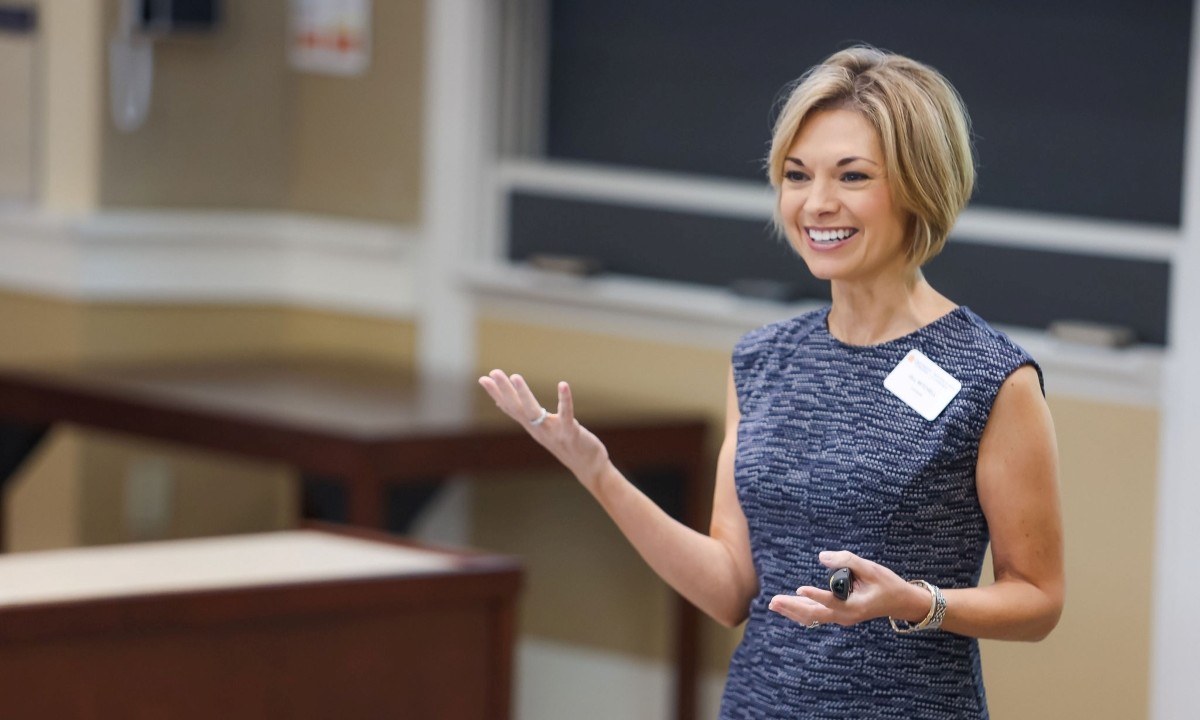

Faculty excellence has always been a defining feature of McIntire. The School’s reputation has been built on scholar-teachers who are deeply invested in their students, curious about the world of business, and willing to evolve alongside it. As we enter the spring semester, McIntire faculty are thinking carefully about what today’s students need most: curricula that reflect real business complexities, research that enlightens, and partnerships that connect learning to real-world experience.
Across disciplines, a few shared priorities rise to the surface: teaching innovation, research with relevance, and experiential engagement that prepare students for leadership in an AI-enabled world.
Rethinking Curriculum for a Changing Business Landscape
Across the Commerce School, faculty are using the spring semester and the rest of the year ahead to rethink not just what they teach, but how students learn. Artificial intelligence, in particular, has become less of a novelty learning shorthand and more of a foundational tool—one that must be integrated thoughtfully.
Thinking Independently, Using Tech Tools Critically

Derick Davis
In marketing and analytics classrooms, that integration has been underway for some time, with Professor Derick Davis having redesigned his Marketing Research course. “My primary focus in 2026 is integrating AI tools into how students learn and practice marketing research,” Davis says. Rather than treating AI as a shortcut, he has restructured assignments so students use tools like Claude and ChatGPT alongside traditional methods. “The goal isn’t to replace methodological rigor,” he explains, “but to teach students how to work with these tools critically, recognizing their limitations while leveraging their strengths.” Students use AI to assist with qualitative analysis, survey design, and iteration, mirroring how research is increasingly conducted in industry.
 A similar philosophy shapes Professor Jingjing Li’s Foundations of Machine Learning and AI course, which centers on data-driven decision-making. “You can think of different business strategies for a company with a problem,” Li explains, “but once you implement a strategy, if it goes wrong, there are irreversible costs.” By applying machine learning to real datasets—whether predicting loan defaults or segmenting customers—students learn to evaluate tradeoffs and consequences, not just technical outputs.
At the programmatic level, other curricular changes are equally significant. Both Professor Christi Lockwood and Professor Robert Parham are preparing for the launch of the new Integrated Core, a shift that brings both excitement and reflection.
Looking ahead, Lockwood sees the new Core as a chance to refresh longstanding content and situate it more clearly within today’s business environment. “What does it look like to have a team in the new age of AI?” Lockwood asks. “How do we think about assigning tasks or setting norms around how we use these tools?”

Jill Mitchell
That same attention to intentional design is central to Lecturer of Commerce and McIntire Teaching Fellow Jill Mitchell’s work, particularly in large foundational courses. After helping launch Foundations of Financial Accounting, alongside Professor Roger Martin, for more than 400 second-year students, Mitchell has seen firsthand how structure and clarity shape confidence. “Students benefit most when we are explicit not only about what they are learning,” Mitchell says, “but also about guiding them on how to learn effectively and independently.” Her focus aims to help students develop professional judgment as they transition from concepts to application.
Finding New Frontiers by Expanding Research Possibilities
While teaching remains front and center, McIntire faculty are also using new tools and data sources to push their research in novel directions, often blurring traditional boundaries between disciplines.
For Davis, that means using conversational AI to advance measurement in consumer psychology. His work leverages a chatbot that allows participants to describe their thought processes in natural language, enabling him to uncover unexpected mediating variables.
“Traditional mediation analysis requires researchers to specify mediators in advance,” Davis explains, pointing out the approach he’s using involves psychological mechanisms that researchers might not have put together and applied in their work.

Christi Lockwood
Lockwood is similarly experimenting with AI-driven methods in her research. She is using image analysis tools and training large language models to code massive datasets of tweets, an effort that gives her the ability to scale insights while preserving nuance. “It’s exciting to actually be tinkering with those tools,” she says, “and using them methodologically to answer research questions that, previously, I couldn’t have asked.”
Beyond individual projects, Lockwood is also working on a conceptual framework for scholars using emerging forms of data from social media and podcasts to digitized trade journals. “We’ve got this proliferation of archival data that allows us to ask new questions,” she notes, “but it’s also so novel that sometimes it can be difficult to gain acceptance for research that uses that data.” Her goal is to help scholars balance innovation with legitimacy, ensuring new methods can generate insights that are both meaningful and credible.
Li’s research and pedagogy intersect through experimentation with custom-built AI agents. Participating in a University-wide pilot, she developed an AI tool designed specifically around her course content. “We are trying to understand if developing AI agents like ChatGPT, but designed specifically for my course, can help students learn,” she says. Early feedback suggests they truly can, which is opening many doors for new forms of personalized learning and support that Li is spearheading.
Mitchell’s scholarly focus, meanwhile, centers on teaching practice itself. Rather than traditional disciplinary research, she studies how students learn in foundational courses and how tools like AI can support reflection and self-assessment without undermining critical thinking. “That work directly shapes my teaching goals for 2026,” she explains, particularly in designing learning experiences that are scalable and aligned with professional expectations.

Robert Parham
Parham, who was part of the McIntire faculty team that won the IQAM Review of Finance Best Paper, remains committed to his scholarly work in 2026 that looks to reach some long sought after statistical findings about monumental global issues. “This year, I’m excited with my new paper that documents a new natural statistical distribution and shows it is the ‘first principles’ distribution of growth, including the growth of companies, the growth of asset prices (i.e., stock returns), the growth of cities, and the growth of populations/pandemics,” he explains. “This has been a holy grail in the finance literature for several decades.”
Industry Partnerships and Experiential Learning
If there is one theme that unites these faculty priorities, it is the belief that learning sticks best when it is connected to real people, problems, and risks.
In Davis’s Marketing Research course, that connection comes through an industry-sponsored partnership with Huckberry, an outdoor lifestyle brand co-founded by Andy Forch (McIntire ’07). Students tackle live research questions, from product feature optimization to content strategy, all while using data collected from Huckberry’s actual target customers. “Students learn methods better when the stakes feel real,” Davis says, emphasizing that their analyses may directly inform business decisions.
Experiential learning also took Davis beyond Charlottesville. As a co-leader of McIntire’s Argentina J-term program in Mendoza, he works with students consulting for local Argentinian wineries on export strategy and brand positioning. The experience blends cultural immersion with consulting that challenges students to quickly navigate ambiguity in a global business context.
For Lockwood, industry engagement is deeply embedded in the Integrated Core, particularly through longstanding relationships with corporate sponsors like Hilton. “That’s always been something for me that brings the lessons from the classroom to life,” she says. Her qualitative research, which relies heavily on interviews with industry professionals, also keeps her closely connected to her interest in the hospitality industry. More recently, she has extended that industry engagement into new sectors, studying companies like Misfits Market and Imperfect Foods as they create demand for products once considered waste.
Mitchell approaches experiential learning through a developmental lens, tailoring opportunities to where students are in their academic journeys. In Auditing, where many students are weeks away from entering the profession, she emphasizes environments that are “rigorous yet safe for students to fail.” Guest speakers and applied discussions help students see how judgment and ethics play out in practice, not just textbooks.
Li’s industry-facing work similarly prepares students for the complexities of the market. Whether through applied business examples or plans for a new generative AI course in the M.S. in Business Analytics Program, her focus remains on helping students translate technical insight into strategic action, such as deriving a new business strategies from large language models and then discussing, in practical terms, how that might function in the workplace.
As McIntire faculty look ahead, their priorities reflect a shared conviction: Commerce education must evolve alongside the world it serves, without losing sight of its human core. As Lockwood puts it, “It’s exciting to reconceptualize some of the assumptions about what we do in organizations, how we relate to one another, and to make our classes relevant in ways that we simply couldn’t before because we didn’t have the tools.”


