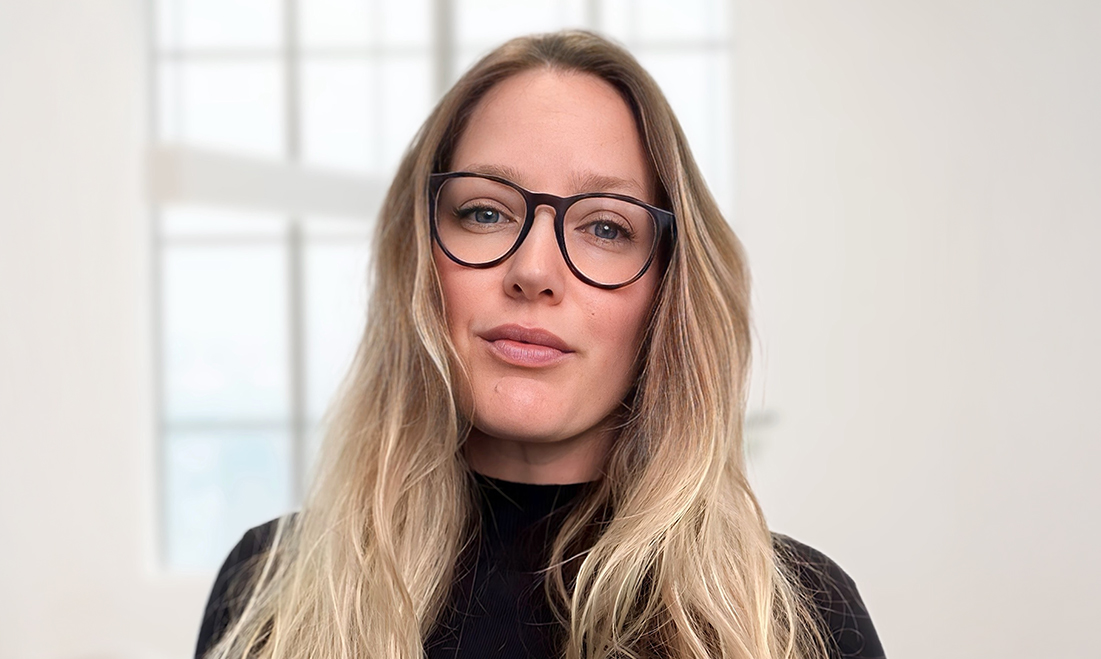

Before she ever ran her first regression model, Hannah Moore (M.S. in Business Analytics ’26) had already built a career defined by navigating complexity and tenacity. She started working at UVA at age 18, moved through multiple corners of the University, from insurance analysis to clinical administration to academic research support, and eventually made her way to translational research, helping big biomedical ideas move from the academic world to real life.
Now as Associate Director of the Wallace H. Coulter Center for Translational Research in the Department of Biomedical Engineering, Moore has spent more than a decade deeply embedded in the University’s research ecosystem. Each new step has reinforced central themes of her professional life: supporting teams, projects, and ideas that can meaningfully shape healthcare.
Today, as an MSBA student, she sees the graduate program offered jointly by the Darden School of Business and the McIntire School of Commerce as the next crucial step in her career story. The experience of gaining leadership roles as she supports faculty and trainees advancing biomedical discoveries, Moore says, made it clear that knowing how to use data strategically wasn’t optional anymore. It was essential.
A Nontraditional Career Path and a Desire to Advance
Moore’s career began with an unlikely entry point into healthcare: insurance analysis. As an 18-year-old, she was learning to balance claims and how medical billing, provider operations, and institutional systems work in practice. “Working as an insurance analyst within the UVA Physicians Group gave me an early appreciation for the operational complexities of healthcare,” she explains.
But moving on from insurance opened even more doors: “I advanced through clinical administration within the Medical Center, learning how systems, people, and processes work together to support patient care.” Those early positions shaped her understanding of healthcare as an interconnected network of decisions, stakeholders, and constraints, knowledge that would later become invaluable in her work in higher education.
A little more than a decade ago, Moore shifted to the academic side of things, where she discovered what she calls her “professional passion.” That shift brought together everything she valued: research, education, innovation, mentorship, and long-term impact. It also laid the groundwork for her decision to pursue further education. “Through this work, I realized how essential it was to use data, not just descriptively, but strategically, to guide decision-making partnerships and investments,” she says.
That realization made the timing for graduate study feel right. It wasn’t a departure from her trajectory, but a deliberate next chapter. “The MSBA program seemed like a good fit. It was a way to strengthen my analytics and strategy toolkit while continuing to grow as a leader in the research and innovation space.”
Using the MSBA to Strengthen Her Analytics, Strategy, and Communication Toolkit
While Moore’s career has long demanded strong communication and decision-making skills, analytics was the piece she wanted to sharpen. She came to the program without a formal background in business analytics but with no shortage of motivation.
“All of it, honestly,” she says when asked which coursework has been most useful. “I’ve gained new fluency in communicating across disciplines, bridging the technical language with strategic needs of leadership within this space.”
For Moore, the value lies in immediate application. “One week, it’s regression modeling, and the next, it’s informing board-level funding decisions,” she says. Because she manages data daily through grant activity, student progress, funding performance, and investment outcomes, the analytical frameworks she learns in class translate directly into action.
This semester, a course on data storytelling unlocked new insights for her work. “I told [Professor Anthony Palomba], ‘This class is blowing my mind,’ because I’m very used to helping faculty refine their grant proposals—and that is the complete opposite of what’s being taught,” she says. Research presentations can be messy, dense, and technical; investors require clarity, narrative, and focus. Learning how to bridge those worlds is already changing how she supports researchers preparing to take their innovations to market.
She credits the program’s faculty for helping her build confidence quickly. She recalls the first residency, when even loading software felt overwhelming. “[Professor] Rick Netemeyer is great,” she says. “He just made the content very relatable… They made very complex content digestible and broke it down in a very eloquent way. That way, it was not as intimidating for somebody who couldn’t even load the R software the first day and wanted to quit after five minutes.”
A Mission in Research, Collaboration, and Mentorship
Moore’s day-to-day responsibilities reflect the complexity and potential of translational research. As Associate Director, she supports trainees and faculty whose discoveries may one day reshape patient care. “My focus is on helping students and researchers translate big ideas into actionable outcomes that serve society,” she says. “I’ve spent my career at UVA, and I’m deeply invested in its ecosystem of innovation and collaboration.”
The MSBA’s cohort model amplifies that collaborative spirit. “That’s the magic dust of it all,” Moore says. “Learning alongside diverse, driven professionals who challenge each other and bring fresh perspectives from every industry has been key.” She notes the wide range of backgrounds that include people representing the military, government, private sector, and technology, and that their input complements her own academic experience. “I applaud my cohort for their ability to pick up and run with things and how we’ve all leaned on each other to help each other through harder content.”
Capstone projects have highlighted just how deep those collaborations run. On one project, Moore’s team advised UVIMCO. Despite her own long partnership with the organization, she quickly realized familiarity offered no shortcuts.
“You would think that would give me a leg up,” she laughs, “Absolutely not.” What mattered was the team’s collective ability to analyze, debate, and present clear recommendations—all skills the program intentionally builds.
Looking Ahead: Analytics as a Pathway to Better Healthcare Systems
For Moore, the MSBA isn’t about checking a box or shifting careers—it’s about equipping herself to accelerate the impact she already works to create. “Looking ahead, I want to continue building bridges between academia and industry,” she says. “Using data-driven insights to accelerate innovation and make systems more effective.”
Her long-term mission remains rooted in improving healthcare through better communication, smarter strategy, and more effective alignment between research and industry needs. “Ultimately, I see this as part of a larger mission to use analytics, not just to understand the world, but to help improve it,” she says.
Even amid the demanding balance of full-time work and graduate study, Moore remains energized by the possibilities ahead. She credits her team for their support and acknowledges the discipline required. Nights and weekends have become dedicated study time, but the effort, she notes, is worth it.
“I told myself this program is the direction we’re going in, in this industry and economy,” she says. “That’s what led me to the MSBA program.”