Karina Arakal studies Biomedical Engineering, but she doesn’t see her strength as operating in a vacuum but instead at the intersection. She notes that the impact of life-saving technology doesn’t only need a strong engineer, but a skill set that can bridge engineering with business strategy. “I like being in that middle.” That preference for operating between two worlds may help show how she found her way to McIntire’s General Business Minor.
For Karina, that perspective grew out of her engineering work. She says it’s easy to develop tunnel vision in a technical space, but the more she worked on real projects, the more she saw that technical brilliance was only half the equation. “A solution, no matter how technically great it can be, can fail if it’s not brought to market in the best way,” she says.
Karina points to surgical devices she has designed with the UVA Department of Biomedical Engineering. A single design decision, she explains, ripples outward: Whether a device is single-use or reusable changes how many units a hospital must buy, how it needs to be cleaned, and where it can realistically be used, from a well-resourced healthcare setting to a low-resource one. “There’s so much more to these technical solutions,” she says. The business questions, she came to realize, were inseparable from the engineering ones.

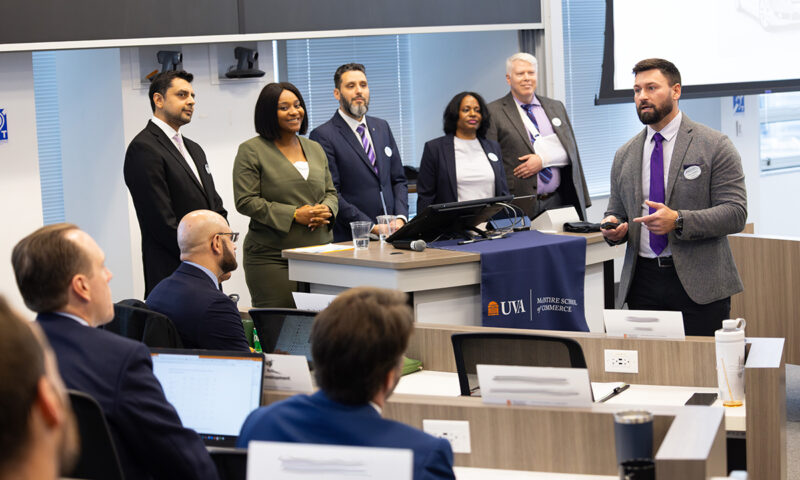
Karina Arakal speaks at UVA Engineering Double Take.
That insight is what drew her to McIntire. Weighing several options, including an Engineering Business Minor, she chose the General Business Minor to be able to study outside her own school, alongside students from other disciplines. As someone who also works at the Foundry, UVA’s student entrepreneurship hub, she also sought a better working knowledge of how companies run. “No matter what job you have, you’re operating within a business,” Karina says. She wanted to learn “the nomenclature of businesses,” from balance sheets to financial statements.
The 15-credit minor is open to any non-Commerce major and covers accounting, finance, marketing, and digital skills. Because of its structure, it gave Karina the ability to explore before committing: Students sample Foundations of Commerce and two core courses before deciding whether to declare, and its electives gave her room to pursue interests such as Commercial Law. Karina especially valued faculty who connected coursework to the professional world; in Foundations of Commerce, for example, she details how Professor David Costanza consistently grounded abstract concepts in real-world examples.
The classmates she has met and collaborated with through the minor have been an equally meaningful part of the experience. Learning with Economics majors and pre-Law students, she found people who knew far more than she did in their own subjects, a deliberate step outside the world where everyone thinks like an engineer.
It’s also been a supportive experience: “It doesn’t feel cutthroat, which is one of my favorite aspects of the minor. It’s still very collaborative,” she says of the courses that retain that essential Commerce School characteristic of students working together.
The lessons she names most readily, though, are the ones that have followed her back into the lab. Her Commerce courses taught her how companies conduct market analysis, so when an engineering project asks who its patients and clinicians are and which market it aims to enter, she now understands how that is accomplished. She has also learned how an engineer functions in processes alongside marketing and finance colleagues who help determine whether a product is likely to succeed. A Marketing course made her aware of how deliberately products are positioned, a lens she began applying in framing her final engineering presentations.
All of this has pointed Karina toward that intersection of engineering and business, and as she approaches graduation in May 2027, she is applying to jobs and graduate programs that blend the two. Since she was drawn to translating technical solutions into products that reach the people who need them, the General Business Minor has given her an avenue to operate in the hub, a middle ground she likes best, where she can develop fluency in both areas and be better able to see how the ideas she builds in the lab could one day solve real healthcare problems.

Karina Arakal is a UVA “Lawnie” this year. (Photo by Lathan Goumas, University Communications)