

UVA McIntire graduates frequently leave Charlottesville bound for finance, consulting, or technology. Azzaam Kapadia (McIntire ’23) chose one of the least predictable, most relationship-driven fields he could have entered. Born and raised in Richmond, VA, he now lives in Minneapolis, where he serves as Assistant Director of Pro Personnel for the Minnesota Vikings. His path shows how the decision-making skills he developed at McIntire now shape his work in an NFL front office.
What drew him was the work itself. Long before he had a job in football, he spent his free time studying rosters, player movement, and organizational decision-making, essentially evaluating talent, solving personnel problems, and helping build a team felt like a natural extension of what already held his attention. He is candid about the tradeoffs. The sports industry is fiercely competitive, jobs are scarce, and there are no guarantees. If you need a clear roadmap, immediate stability, or the prestige of professional sports, he says, this probably is not the right field. But if you are willing to embrace uncertainty, keep learning, and stay committed when there is no obvious way forward, it can be deeply rewarding.
That willingness to commit traces back to his family. Kapadia’s parents immigrated from India in the 1990s with very little, set on creating better educational opportunities for him and his older sister, and they taught him that once you choose a path, you commit to it fully. He also did not know anyone of Indian descent on the personnel side of an NFL front office, which is part of why he believes visibility matters. That mix of commitment and persistence is what carried him into rooms he had no obvious way into. Once there, he says, the expectations are the same for everyone: Contribute, earn trust, and help the team win.

Q: What did a Commerce degree give you that shows up in a draft room, and where did it leave gaps you had to fill on your own?
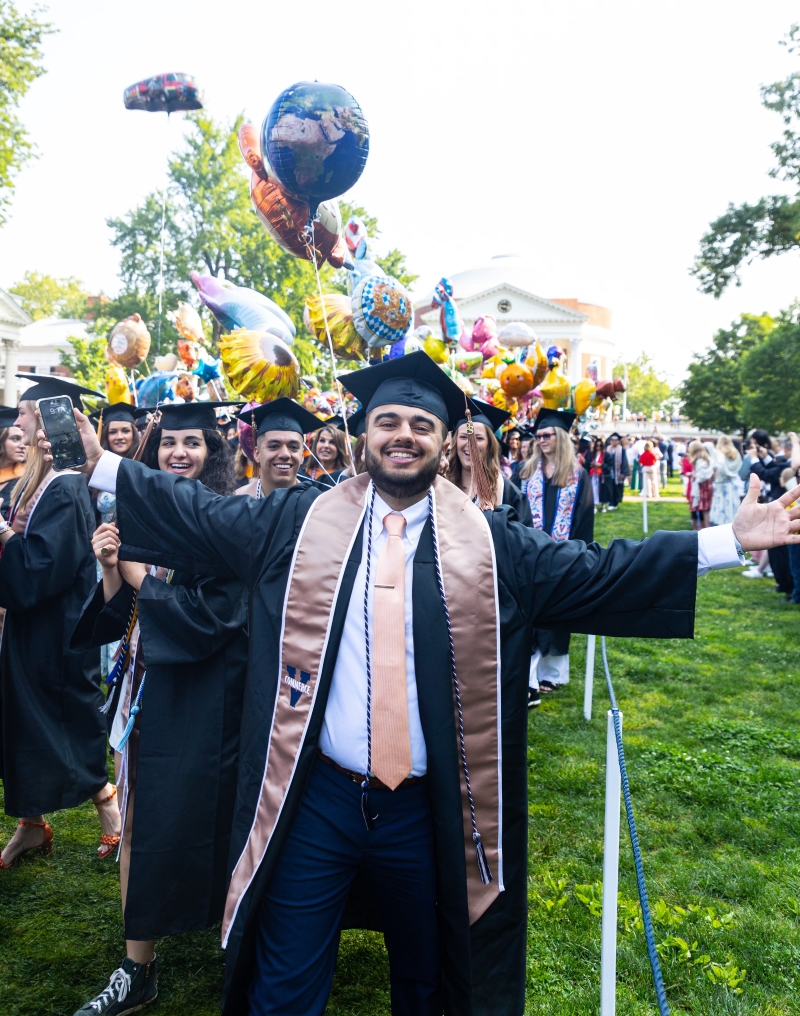 Kapadia: A Commerce degree gave me a strong foundation in analytical thinking, communication, and decision-making. At McIntire, you’re constantly working through complex problems with imperfect information, evaluating tradeoffs, and defending your recommendations. That translates surprisingly well to player personnel because very few decisions in football come with complete certainty.
Whether you’re discussing a draft prospect, a free agent, or a potential trade, you’re gathering information, weighing risks and rewards, and making projections about future outcomes. The ability to think critically, communicate clearly, and challenge your own assumptions is valuable in any draft room.
Outside of McIntire, I had to learn player evaluation, roster construction, salary cap management, contract structures, and the nuances of how NFL organizations operate. Those lessons didn’t come from a classroom. They came from mentorship, hands-on experience, and thousands of hours studying the game in my free time.
Q: How do you break into football with no connections, and what does that say about how much a credential is really worth versus a network?
 Kapadia: Breaking into football without connections is difficult, but not impossible. Early in my career, I focused on putting myself in environments where I could learn and contribute. While attending UVA, I worked for the football program in the recruiting and video departments and spent summers doing internships with the Indianapolis Colts and Athletes First. Those experiences gave me exposure to multiple sides of the industry and helped me develop both the knowledge and relationships that were crucial in building my career.

Azzaam Kapadia interned with the Indianapolis Colts.
I think people often frame it as credentials versus networking, but the reality is that both matter. Credentials can help open a door, and relationships can help create opportunities, but neither is a substitute for the quality of your work. Once you get an opportunity, what matters most is whether you’re prepared, whether you add value, and whether people trust your judgment.
The best networking advice I can give is to focus on learning and creating value first. You have to be relentless in your efforts to gain knowledge and build relationships. Reach out to people to learn, not to ask for a job. For every 100 emails, text messages, or LinkedIn messages I sent, I may have received five responses. But those five responses were instrumental in helping me learn, expand my network, and ultimately find a path into the NFL.
Q: Evaluating an NFL player and evaluating a company or investment both come down to reading talent under uncertainty. Where do those two disciplines actually overlap, and where does one break the other’s rules?
Kapadia: There are more similarities between player evaluation and evaluating a company or an investment than most people realize. In both cases, you’re trying to make informed decisions about future outcomes using incomplete information. You identify strengths, weaknesses, risks, and opportunities while making projections about performance over time. Both disciplines require balancing quantitative and qualitative information. Just as investors evaluate financial metrics alongside management teams and market conditions, NFL personnel staffs evaluate measurable data alongside film, character, medical information, and organizational fit.
Where the comparison starts to break down is that football is ultimately a people business. Companies don’t suffer injuries, lose confidence, change motivations, or respond differently to environments. Players do. While data and historical performance are important, some of the most important variables in football involve people, and those variables don’t always fit onto a spreadsheet. That’s what makes player evaluation both difficult and fascinating.
Q: If player evaluation tells you who is valuable, roster construction under a salary cap asks how much that value is worth under constraints. How much does pro personnel work resemble running a balance sheet versus scouting a player?
Kapadia: There are definitely similarities to portfolio management because every team operates with finite resources and every decision comes with an opportunity cost. You’re constantly balancing short-term needs with long-term flexibility, evaluating risk, and trying to maximize the value of every roster spot and dollar spent.
That said, roster construction starts with player evaluation. The salary cap, contract structures, and financial planning are all important, but they only matter if you have the right assessment of the player. The salary cap determines what you can do, but player evaluation determines whether you should do it. The financial side helps guide decision-making, but the foundation of scouting will always be identifying and acquiring the right players.
Q: How has analytics changed what a scout does day to day, and what still can’t be captured in a model no matter how good the data gets?
Kapadia: Analytics have significantly enhanced player evaluation by providing additional context and helping teams challenge assumptions. Scouts have access to more information than ever before, and the best organizations use analytics as another tool to improve decision-making rather than as a replacement for traditional scouting. Data can help identify trends, uncover potential inefficiencies, and provide an objective perspective that complements film evaluation.
At the end of the day, you have to trust the tape. There are 21 other players on the field on every snap, creating countless variables that data alone can’t always account for. The best decisions typically come when both perspectives challenge and strengthen one another.
Q: What’s a widely accepted belief in scouting or player evaluation that you’d bet against, and where do you think the field is heading in the next decade?
Kapadia: One belief I’d challenge is that there is a perfect prototype for every position. Measurables, athletic testing, and physical traits are important, but players win in different ways. Some of the best players in the league have succeeded because teams focused on what they could do rather than what they couldn’t.
I think the future of player evaluation will be less about finding a universal standard and more about understanding context. Teams are getting better at identifying which players fit specific schemes and cultures rather than evaluating everyone against the exact same benchmark.
Over the next decade, I expect organizations to continue integrating scouting, analytics, sports science, and medical research more closely than ever before. Teams will have better information and more helpful tools, but football is ultimately a game played by people. Evaluating the people who play the sport will always be one of the most important parts of building a successful team.
Q: What’s the best thing about doing what you do, and how much of that has changed between the various NFL teams you’ve worked with in the last few years?
Kapadia: The best part of working in player personnel is that there is always something new to learn. Every day presents a different challenge, whether it’s evaluating players, preparing for upcoming opponents, discussing roster decisions, or identifying ways to improve the team.
I’ve also been fortunate to work with top-tier people and organizations so far. While every organization has its own processes and philosophies, the best ones all share a commitment to collaboration, communication, and preparation. I believe that shared commitment is a big part of what made our Super Bowl team in Seattle so successful.

Azzaam Kapadia holding the Super Bowl LX trophy.
Q: What are you looking forward to most about the 2026 NFL season?
Kapadia: Coming off a Super Bowl season with the Seattle Seahawks and now joining the Minnesota Vikings, I have an exciting new challenge ahead. I was fortunate to witness firsthand what it takes to build a Super Bowl-winning roster and organization, and what I’m most excited about is the chance to apply those lessons here.
If there is one thing I took from Seattle, it is that building a winning team requires alignment, preparation, and a tremendous amount of work from people across the entire organization. I’m grateful to be part of that process and to help bring the Vikings their first Lombardi Trophy.

Azzaam Kadapia and Seattle Seahawks’ Southwest Area Scout Ryan Florence.


